FOLLOW US ...
Customers at heart,
Focus on data
The AIC Group’s Marketing Automation Suite enables marketing experts to address customers in a targeted manner and in real time across various channels – centrally controlled via the AIC Marketing Engagement Platform.
Revolutionize your campaigns with our Customer Engagement Platform and Marketing Automation Suite. Your email, SMS, web, and mobile campaigns are personalized via a central platform, seamlessly integrating all communication channels.
With the help of real-time data and state-of-the-art artificial intelligence, campaigns are precisely tailored to the individual needs of your customers.
The result: a highly personalized customer experience that impresses and increases customer engagement.

With our Customer Data Platform (CDP), you can integrate contact data from different sources into one central system. This gives you a comprehensive understanding of your customers’ needs, enabling you to create personalized content and messages.
This content can be targeted via various communication and marketing channels to increase customer satisfaction and promote long-term customer engagement. Our scalable, data protection-compliant CDP meets the growing demands of your marketing automation.

Our Customer Audiences enable you to divide customers into target groups based on their characteristics using logical operators. Use real-time data to create dynamic segments and deliver personalized content using conditional blocks.
This ensures that your messages reach exactly the right people—for a personalized customer journey, more effective campaigns, and lasting customer loyalty. Scalable, flexible, and compliant with data protection regulations.

Successful marketing automation thrives on inspiring customer journeys. With AIC Canvas, you can create and control automated workflows that are optimally tailored to your use cases. Thanks to the link to our Customer Data Platform (CDP), you benefit from real-time data to control your marketing workflows.
Use your resources efficiently and create relevant, personalized experiences—for stronger customer loyalty and sustainable marketing success.

Use the Content Creation Suite to efficiently, intuitively, and flexibly design highly personalized and powerful messages for different channels. Our innovative tool combines all the features you need for professional and seamless content creation.
Advantages at a glance:

Our powerful cross-channel marketing solution enables you to orchestrate cross-channel strategies with maximum impact. Through integration with our Customer Data Platform (CDP), you can use real-time data to automatically deliver highly relevant content via email, push notifications, webhooks, and other channels.
This allows you to create seamless and personalized experiences that increase engagement and build long-term customer loyalty.

Effective personalization requires consistent customer data. By integrating our Customer Data Platform (CDP), you can create individual profiles and segment your target groups precisely.
This allows you to dynamically customize content and deliver it in a targeted manner via email, push notifications, and webhooks. Relevant, context-based experiences not only increase engagement rates, but also promote long-term customer loyalty.

The Customer Data Platform (CDP) is the foundation for accurate analytics and informed marketing decisions. With consistent customer data, you can create meaningful reports and dashboards that provide deeper insights into campaign performance and customer behavior.
Use the insights gained to identify potential for optimization and increase the efficiency of your marketing measures.

Our Customer Insights Suite (CIS) uses artificial intelligence to accurately predict your customers’ future behavior based on in-depth analyses of their current behavior. We offer a wide range of use cases and customized solutions for targeted and effective customer communication.
Thanks to intuitive context definition, our Next Best Offer (NBO) module can be used flexibly and reused without IT expertise—integrated seamlessly and in real time into apps, emails, push notifications, and other channels.

through centralized & automated control

through optimized campaigns

through modular design

through extensive reporting
Would you like to improve your marketing automation skills or learn more about this topic?
Then get in touch with us!
Your contact for Customer Engagement Platform
Vor einigen Monaten haben wir bei der AIC Group GmbH begonnen, intern einen KI-Agenten aufzubauen. Nicht als formales Pilotprojekt. Nicht mit externer Agentur. Nicht über ein IT-Ticket.
Dass das Thema gerade überall ist, war auch auf der OMR in Hamburg deutlich zu spüren: Keynotes, Podiumsdiskussionen, Pausengespräche. Was uns dabei auffiel: Viele Unternehmen wissen, dass sie sich mit Agentic AI auseinandersetzen sollten. Aber der Einstieg fühlt sich oft groß an. Nach IT. Nach Budget. Nach externer Lösung. Nach Zeit, die gerade fehlt.
Genau dieses Muster kennen wir. Und wir wissen inzwischen aus eigener Erfahrung: Es gibt einen anderen Weg.
Der Use Case: Content Creation. Konkret die Planung und Ausarbeitung unserer LinkedIn- und Instagram-Posts.
Warum genau dieser Use Case? Weil er niedrigschwellig ist. Marketingcontent ist öffentlich zugänglich – er enthält keine vertraulichen Informationen, keine sensiblen Daten. Man braucht kein aufwändiges Datenprojekt, um zu starten. Was man braucht, ist ein klares Vorgehen.
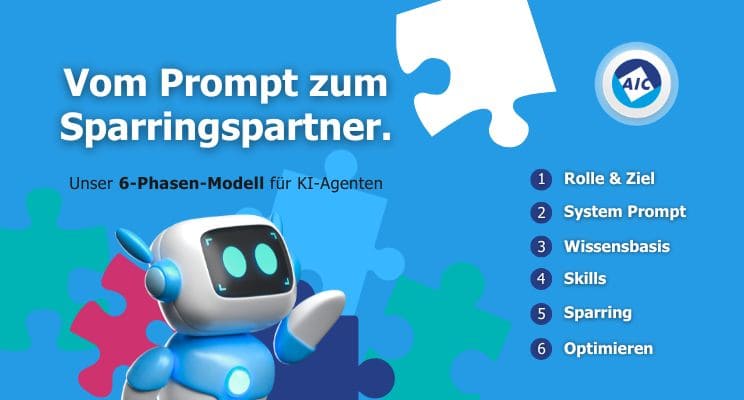
Ein funktionierender Agent ist kein Zufallsprodukt. Er entsteht durch Entscheidungen – und durch Iteration. Unser Prozess folgt sechs Phasen.
Phase 1 – Rolle & Ziel definieren
Wofür soll der Agent eingesetzt werden? Was sind seine Aufgaben – und was ausdrücklich nicht? Ohne diese Klarheit bleibt der Agent generisch.
Phase 2 – System Prompt entwickeln
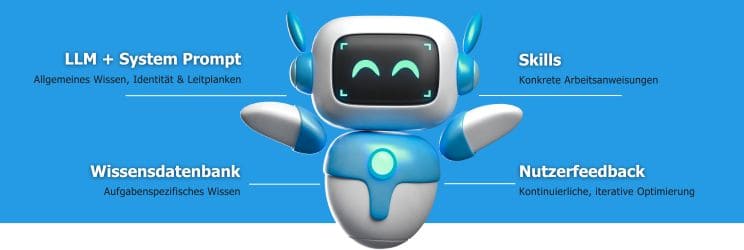
Der System Prompt ist das Herzstück. Er definiert Kontext, Rolle, Tonalität, Arbeitsweise und Qualitätsansprüche. Er macht den Agenten nicht kreativ – er macht ihn verlässlich.
Phase 3 – Wissensdatenbank aufbauen
Ein Agent ist nur so gut wie das Wissen, das ihm zur Verfügung steht. Wir haben dafür strukturierte Dokumente erstellt: Positionierungsgrundlagen, Sprachregeln, Designvorgaben, Redaktionspläne.
Drei Typen von Quellen haben sich dabei bewährt: strategisch-fachliche Dokumente, Stil- und Formatvorgaben sowie Planungsunterlagen.
Wissen schlägt Prompt-Länge.
Phase 4 – Skills entwickeln
Für wiederkehrende Aufgaben haben wir vordefinierte Arbeitsanweisungen entwickelt – sogenannte Skills. Sie sorgen dafür, dass der Agent konsistente, reproduzierbare Ergebnisse liefert, ohne jedes Mal neu instruiert zu werden.
Die Wissensdatenbank liefert das Was und Warum, der Skill das Wie.
Phase 5 – Arbeiten mit dem Agenten
Ein Agent ist kein Texter. Er ist ein Sparringspartner.
Dialog statt perfekter Prompts. Feedback statt Neuanfang.
Wer so arbeitet, kommt schneller zu besseren Ergebnissen.
Phase 6 – Kontinuierlich optimieren
Jeder falsche Output ist eine Lernchance. Die Optimierungsschleife – Fehler erkennen, Ursache identifizieren, nachschärfen – ist entscheidend für die langfristige Qualität.
Jeder falsche Output macht den Agenten besser.
In Gesprächen mit anderen Unternehmen – und beim Besuch von KI-Anbietern, die uns ihre Lösungen vorstellen – beobachten wir dasselbe Muster immer wieder.
Viele Anbieter bauen Oberflächen, die genau das zugänglich machen, was einen Agenten ausmacht: System Prompt, Wissensdatenbank, vordefinierte Arbeitsanweisungen. Dahinter steckt ein Sprachmodell, ergänzt um Integrationen – in die Website, ins CMS, in bestehende Workflows.
Das ist kein schlechter Ansatz. Aber er löst eine Herausforderung nicht: Den Unterbau sauber aufzubauen.
Was soll der Agent wissen? Wie soll er kommunizieren? Welche Aufgaben soll er reproduzierbar erledigen? Diese Arbeit bleibt immer. Egal ob mit eigenem Agenten oder mit einem Dienstleister.
Genau das hat unsere Entscheidung bestätigt: Wir bauen den Unterbau selbst. Nicht weil wir Tools ablehnen – sondern weil wir verstehen wollen, was einen guten Agenten ausmacht. Und weil dieses Wissen wiederverwendbar ist. Für den nächsten Use Case. Und den übernächsten.