
FOLLOW US ...
Frequently Asked Questions (FAQ).
What would you like to know? Just ask us!
The following topics are currently being translated into English:
FAQ SECTION: Marketing Automation - Our MAS
FAQ SECTION:Agentic AI
FAQ SECTION: BI-Consulting & Analytics
Learn more about us!
What exactly does AIC Group do?
AIC Group stands on three pillars: the Marketing Automation Studio (MAS) as its own customer engagement platform, consulting on AI agents, and BI consulting since 1999. What connects them is the same working foundation – reliable data.
In which areas does AIC Group have the strongest expertise?
In three fields: marketing automation with its own platform, building AI agents, and business intelligence from strategy to operation. In addition, there are software development, project management, training and support.
Is there also campaign management software?
Yes. The Marketing Automation Studio (MAS) is our own customer engagement platform. Classic campaign management is included in it; the focus is on multi-step, event-based journeys.
For which BI solutions is consulting offered?
The focus is on Strategy (formerly MicroStrategy), where we are a Premium Partner, and Power BI from Microsoft. Which tool is used in the project depends on your system landscape.
Does AIC Group work with partners? If so, with which ones?
Yes. In the BI field, we are a Premium Partner of Strategy and a partner of STACKIT, the European hyperscaler from the Schwarz Group. In the marketing field, we work with Inxmail, among others. The complete overview is on our partner page.
If you have further questions about AIC Group in general, please write to us using our contact form. We look forward to your message!
Introduction to marketing automation
1. What is marketing automation, and what strategic benefits does it offer to medium-sized and large companies?
Marketing automation refers to the software-supported automation, control and optimisation of marketing and communication processes along the entire customer journey. This includes, among other things, building target groups, personalised communication, trigger campaigns, lead nurturing, content delivery, campaign control and reporting.
For companies, this results in a clear strategic benefit: marketing becomes more efficient, more measurable and more scalable. Recurring tasks run automatically, while teams gain more time for strategy, creative work and optimisation.
From the point of view of AIC Group in particular, marketing automation is more than a pure sending or campaign tool. With the Marketing Automation Studio (MAS), we offer a customer engagement platform (CEP) that connects data, target groups, content, workflows, cross-channel communication and analytics in one central platform. The result is not isolated individual measures, but consistent, data-driven marketing processes.
Typical challenges are, for example:
• manual campaign processes that take a lot of time
• unconnected data sources from CRM, shop, ERP or service
• a lack of personalisation in email and existing-customer communication
• little transparency about conversion, customer behaviour and ROI
This applies to small and medium-sized businesses as well as large enterprises. Small teams benefit from reduced workload and improved structure, while larger organizations benefit from scalability, governance, and cross-channel orchestration.
More information on marketing automation:
2. WHY is personalized and data-driven marketing becoming a key competitive advantage for businesses?
Customers today expect relevant content, suitable offers and communication that fits their current situation. General mass communication, by contrast, causes high wastage, declining relevance and inefficient marketing budgets.
Data-driven marketing creates the basis for systematically analysing customer behaviour, interests, purchase patterns and response signals. This is exactly where AIC Group comes in with the MAS: with one central data base, dynamic target groups and automated workflows, content and offers can be delivered far more precisely.
These include, for example:
• personalised product recommendations for existing customers
• reactivation of inactive contacts
• individual offer communication based on click or purchase behaviour
• communication geared to the Next Best Offer
• cross-selling and upselling campaigns based on real customer data
Companies that deliver relevant communication at the right moment are perceived in the long term as more helpful and more customer-oriented.
AIC brings to this the experience of more than 25 years of data-driven marketing, business intelligence and marketing automation. This expertise helps in particular to develop from data not just reports, but communication logic that actually works.
More information on personalisation: https://www.aicgroup.de/en/marketing-automation/#personalisierung
3. How does marketing automation improve the entire customer journey—from the initial contact to long-term customer loyalty?
The customer journey covers all touchpoints between company and customer – from first interest through the purchase to service, loyalty building and repeat purchase. Marketing automation ensures that these touchpoints are not isolated, but systematically connected with one another.
With the MAS from AIC Group, customer journeys can be orchestrated in an automated, multi-step and cross-channel way. As a result, customers do not receive just any message, but the communication that fits in each case – depending on behaviour, attributes, events and timing.
Typical use cases are, for example:
• welcome journeys after sign-up
• abandoned-basket campaigns
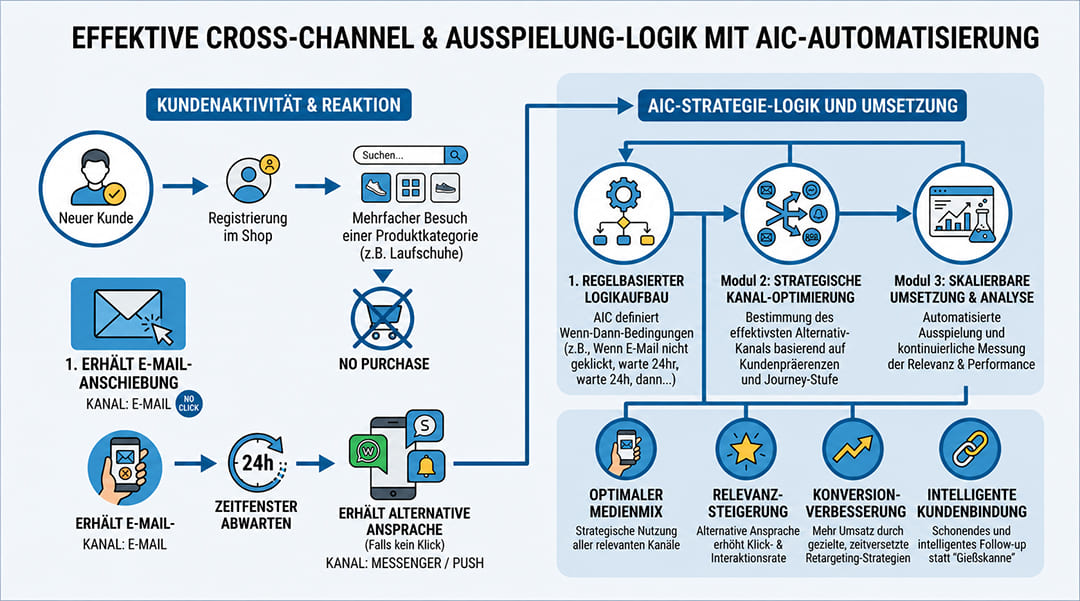
• birthday campaigns
• lead nurturing after a download or contact enquiry
• reactivation in the event of inactivity
• after-sales journeys for repeat purchases, accessories or service offers
A simple example:
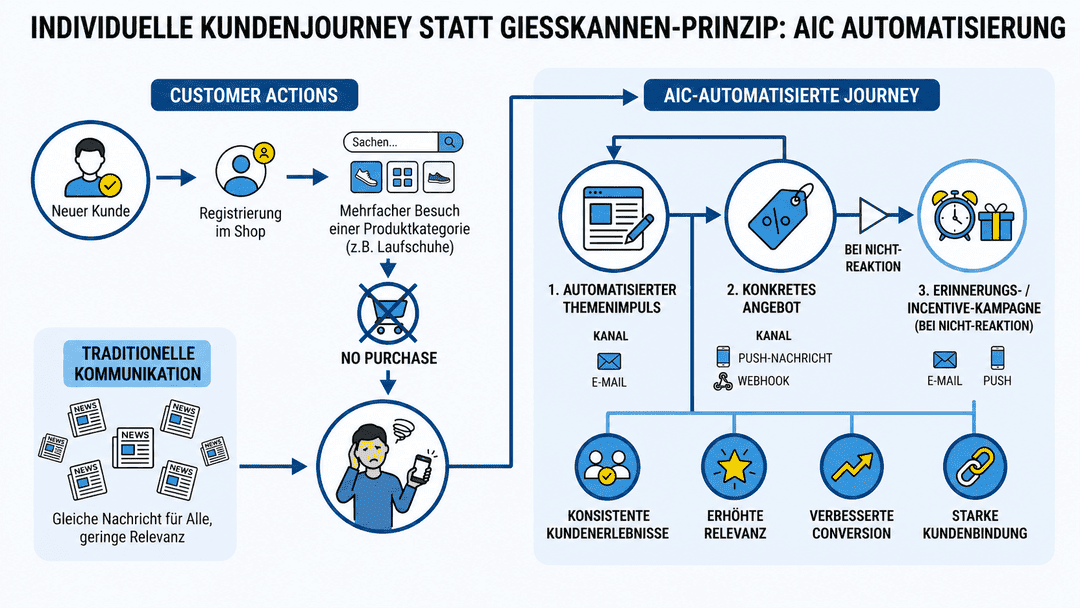
A customer registers in the shop, then visits a product category several times, but does not buy yet. Instead of general newsletter communication, the system can automatically trigger first a suitable topic prompt, then a specific offer and later – if there is no response – a reminder or incentive campaign.
This creates consistent customer experiences across email, push, webhooks and further touchpoints. That improves not only conversion, but also perceived relevance and with it customer loyalty.
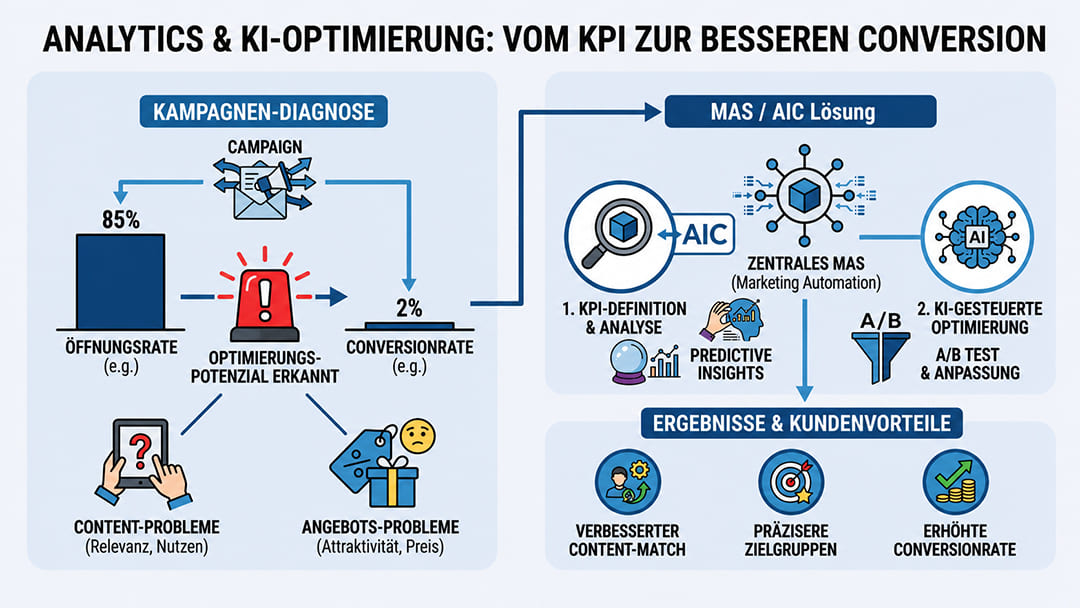
More information on Automation Workflow: https://www.aicgroup.de/en/marketing-automation/#automation-workflow
4. What is a Customer Engagement Platform (CEP), and why is it replacing standalone marketing tools?
A customer engagement platform (CEP) is a central platform for data-driven, automated and personalised customer communication. It connects customer data, target groups, campaign logic, content, delivery channels and analyses in one coherent system.
This is exactly how the Marketing Automation Studio (MAS) from AIC Group is positioned: as a customer engagement platform that supports companies in implementing cross-channel, automated and AI-supported campaigns.
The big advantage over isolated individual solutions lies in working end to end. Instead of separate tools for email, target groups, analyses, content and trigger logic, the company works on one shared basis.
Typical disadvantages of isolated tools are, for example:
• data silos between marketing, sales and service
• duplicate data maintenance
• media breaks in processes
• inconsistent customer communication
• limited measurability
• a high level of coordination effort between teams and systems
With a CEP, these breaks can be reduced. For this purpose, the MAS consists of five modules:
• Customer Data Platform (CDP)
• Marketing Automation – Campaigns
• Marketing Automation – Automation Workflow
• Content Creation Suite (CCS)
• Customer Insights Suite (CIS)
Their interplay gives rise to:
• Customer Audiences
• Cross-Channel
• Personalisation
• Customer Analytics
The result is end-to-end, personalised and scalable customer communication for mid-sized companies, enterprise companies and growing organisations.
More information on customer engagement platform: https://www.aicgroup.de/en/marketing-automation/
5. What is the difference between CRM systems and marketing automation platforms in practical business use?
A CRM system serves primarily to manage customer data, contacts, sales information and customer histories. It mainly supports sales and service processes.
A marketing automation platform goes considerably further: it actively uses data to form target groups dynamically, control customer journeys, personalise content and deliver campaigns automatically across different channels.
In practical use, this means:
• The CRM documents and manages.
• Marketing automation activates and orchestrates.
The great potential lies precisely in the interplay. With the MAS, AIC Group integrates relevant data sources specifically into one central marketing logic. This allows CRM data, behavioural data, purchase data and event data to be used together to trigger relevant communication.
These include, for example:
• automated follow-ups after sales events
• targeted existing-customer communication
• segmentation by behaviour and attributes
• campaigns for prospects, leads and existing customers
• closed-loop processes between marketing response and evaluation of results
So companies do not have to choose between CRM and marketing automation. What matters is an architecture in which both systems play to their respective strengths. This is exactly what AIC develops tailored solutions and integration scenarios for.
More information on Customer Data Platform: https://www.aicgroup.de/en/marketing-automation/#data-platform
6. What measurable competitive advantages does data-driven and automated marketing provide?
Data-driven and automated marketing delivers measurable benefits across multiple areas: efficiency, relevance, revenue, transparency, and scalability.
Typical effects include, for example:
• higher open and click-through rates
• higher conversion rates
• lower wastage
• reduced manual effort in marketing
• faster campaign rollout
• better prioritization of target groups and measures
• stärkere Kundenbindung
• transparenteres Reporting bis hin zum Marketing-ROI
A simple ROI example:
A company invests 10,000 euros in an automated campaign targeting existing customers. Improved segmentation, trigger logic, and personalized offers generate an additional 35,000 euros in contribution margin. The net profit after deducting the investment is 25,000 euros. This corresponds to an ROI of 250 percent.
The AIC Group helps companies not only identify such opportunities in theory but also implement them in practice—from the data foundation and campaign logic to performance analysis.
Based on our project experience with companies in retail, banking, insurance, and other industries, we know that competitive advantages arise above all when technology, data, and use cases work together seamlessly.
More information on Customer Analytics: https://www.aicgroup.de/en/marketing-automation/#customer-analytics
7. How does marketing automation demonstrably increase revenue, efficiency, and marketing productivity?
Marketing automation boosts revenue because customers receive more relevant content and offers—precisely when they are most likely to make a purchase. At the same time, it increases efficiency by automating repetitive tasks and standardizing processes.
In the AIC Group’s MAS, several components work together to achieve this:
• central database
• dynamic target groups
• automated workflows
• personalized content
• cross-platform distribution
• Analytics and Optimization
Typical revenue drivers include, for example:
• Shopping Cart Abandonment Rates
• Rebuy campaigns
• Cross-selling after purchase
• Upselling to Existing Customers
• Reactivating dormant customers
• personalized recommendations based on behavioral and purchase data
Typical ways to improve efficiency include, for example:
• Automated selections instead of manual list maintenance
• Standardized templates instead of custom production
• Triggers instead of manual scheduling
• Consolidated reporting instead of data collection from individual systems
This leads to a noticeable increase in marketing productivity: teams are able to run more campaigns that are of higher quality and have a lower error rate. For companies with ambitious growth goals in particular, this is an important step toward scalable marketing.
More information on Content Creation: https://www.aicgroup.de/en/marketing-automation/#content-creation
8. How does marketing automation support small teams in small and medium-sized businesses despite limited time and staff resources?
Small marketing teams, in particular, are often under a lot of pressure: they have many tasks, little time, and limited resources, yet they’re expected to communicate in a professional, personalized, and measurable way.
Marketing automation is particularly helpful in this regard because it automates routine tasks and streamlines processes. The AIC Group has deliberately designed MAS so that companies can work effectively even with small teams—without having to compromise on enterprise-level functionality, scalability, or personalization.
Typical examples of relief include:
• automated welcome and information kiosks
• predefined audience logic
• Reusable content blocks and templates
• Triggered campaigns instead of manual individual actions
• Centralized campaign management and reporting
A typical case involving a small or medium-sized business:
A company with a small marketing team wants to welcome new customers, re-engage existing customers, and send out seasonal campaigns. Without automation, this would require manual selection, content customization, and scheduling. With MAS, these processes can be set up once and then run largely automatically.
This enables even smaller teams to achieve professional, data-driven customer communication. At the same time, the system remains flexible enough to accommodate additional channels, use cases, or AI-powered decision-making logic in the future.
More information on Customer Audiences: https://www.aicgroup.de/en/marketing-automation/#customer-audiences
9. At what point does marketing automation become worthwhile for small and medium-sized, growing, and large companies?
Marketing automation usually pays off sooner than many companies realize. It’s not just for companies with million-dollar budgets or massive marketing departments—it’s already beneficial when communication is ongoing, multiple target groups are being served, or data from various sources is being consolidated.
Typical signs include, for example:
• increasing manual effort in campaign implementation
• many recurring communication opportunities
• different target groups with varying needs
• lack of personalization
• complex data landscapes
• Lack of transparency regarding impact and ROI
• wachsende Anforderungen an Skalierbarkeit und Geschwindigkeit
Marketing automation is particularly beneficial for small and medium-sized businesses that want to achieve greater impact with lean teams.
For enterprise-level companies, the focus is often on orchestrating complex data, channel, and process landscapes. For smaller businesses, even a clearly defined starting point—such as trigger campaigns or communications with existing customers—can have a significant impact.
The AIC Group takes a pragmatic approach here: rather than starting with an unnecessarily complex setup, we begin with practical use cases and a robust target architecture. Where the portfolio only partially covers a given area, we work together to develop suitable solutions and integration paths.
More information on Marketing Automation: https://www.aicgroup.de/en/marketing-automation/
10. IS the Marketing Automation Studio (MAS) also suitable for agencies?
Yes. Agencies are among the target groups for which we develop the MAS. The platform is multi-tenant: an agency looks after several clients in environments that are cleanly separated from one another. Roles and permissions define who may work in which tenant.
11. WHICH typical marketing problems can be solved for the long term through automation?
Marketing automation primarily addresses issues caused by manual processes, media disconnects, data silos, and a lack of relevance in communication.
Typical challenges are, for example:
• uncoordinated individual campaigns
• Inconsistent messaging across different channels
• time-consuming target audience selection
• missing trigger logic
• insufficient personalization
• Lack of transparency regarding campaign success
• hohe Fehleranfälligkeit in wiederkehrenden Prozessen
• zu geringer Output trotz hohem Teamaufwand
The AIC Group’s MAS allows these issues to be addressed systematically by consolidating data, target audiences, workflows, content, and analytics into a single platform.
A typical example:
A retailer sends the same newsletter to all contacts. The result: high wastage, declining relevance, and low conversion rates. Instead, automated segmentation and trigger logic allows different target groups to be addressed separately—such as cart abandoners, active buyers, dormant existing customers, or high-value customer segments.
That reduces operational friction, improves the customer experience and increases the effectiveness of marketing for the long term.
More information on Automation Workflow: https://www.aicgroup.de/en/marketing-automation/#automation-workflow
12. WHICH areas of a company benefit most from marketing automation?
Marketing automation delivers its greatest benefit not only in marketing, but wherever customer data, communication and response processes work together.
Those that benefit most:
• Marketing, through more efficient campaigns, personalisation and better measurability
• Sales, through better prepared leads, more context on customer behaviour and coordinated processes
• Customer service, through more relevant service communication and a better view of interactions
• Management, through more transparent reporting, a better basis for decisions and greater predictability
• E-commerce and CRM teams, through closer integration of data, campaigns and conversion goals
That is why AIC Group does not think of marketing automation in isolation, but as part of a company-wide customer engagement strategy. This is also reflected in our closed-loop understanding: Data → Insights → Activation → Feedback.
In more complex organisations in particular, this is a significant added value. Departments no longer work with separate sets of data, but with a shared logic for target groups, communication and evaluation.
More information on Customer Analytics: https://www.aicgroup.de/en/marketing-automation/#customer-analytics
13. WHY is marketing automation a central building block of digital transformation?
Digital transformation does not just mean digitising analogue processes. Above all, it means reorganising business and communication processes so that they are data-based, scalable and customer-oriented.
Marketing automation is a central building block for this because it connects data, technology and operational implementation. It puts companies in a position to respond more quickly to market changes, customer needs and new requirements
The MAS from AIC Group supports this change with a modular, scalable platform logic. Companies can build up functions step by step, for example:
• central customer data management
• dynamic audience building
• automated customer journeys
• personalised content delivery
• cross-channel communication
• performance analyses and AI-supported decision support
This is just as relevant for mid-sized companies as it is for enterprise companies. While mid-sized companies gain efficiency and professionalisation above all, larger organisations also benefit from standardisation, governance and scalable orchestration.
Last but not least, the experience from more than 25 years of AIC Group shows: digital transformation works particularly well when technology is not introduced in isolation, but as part of a viable data, process and communication strategy.
More information on customer engagement platform: https://www.aicgroup.de/en/marketing-automation/
If you have further questions about the introduction to marketing automation, please write to us using our contact form We look forward to your message!
Data integration & Customer Data Platform (CDP)
14. WHAT is a Customer Data Platform (CDP) and what role does it play in the Marketing Automation Studio (MAS)?
A Customer Data Platform (CDP) is the central data base for modern, data-driven marketing. It collects, unifies and structures customer data from different sources and makes it available for use in marketing, sales and analysis.
In the Marketing Automation Studio (MAS) from AIC Group, the CDP forms the foundation for all other functions. Without a consistent data base, neither precise target groups nor personalised campaigns or automated customer journeys are possible.
The CDP in the MAS integrates, for example, data from:
• CRM systems
• online shops
• ERP systems
• web tracking and app usage
• campaign responses (email, clicks, conversions)
This data is merged into a unified customer profile. The result is a complete picture of customer behaviour – across all touchpoints.
Typical advantages:
• 360° customer view
• consistent data for all departments
• basis for segmentation and personalisation
• better basis for decisions on marketing measures
Here AIC Group contributes its experience from more than 25 years of data integration, business intelligence and marketing automation. What matters most is not just collecting data, but making it usable in a structured way for specific marketing applications.
More information on Customer Data Platform: https://www.aicgroup.de/en/marketing-automation/#data-platform
15. WHY is consolidated customer data the basis for successful marketing?
Successful marketing is based on relevance – and relevance only arises when companies really understand their customers. Isolated data sources prevent exactly that.
Consolidated customer data makes possible:
• a unified view of the customer
• the linking of behaviour, purchase history and interests
• well-founded decisions instead of gut feeling
Typical problems without data consolidation:
• contradictory customer data in different systems
• duplicate or incorrect data records
• imprecise targeting
• a lack of personalisation
• inefficient campaigns
With the MAS from AIC Group, data is brought together centrally and activated for marketing processes. This produces precise target groups and automated campaigns that are based on real behaviour.
Example:
A customer regularly buys certain product categories in the shop, but still receives generic newsletters. With consolidated data, a personalised product recommendation can be delivered in a targeted way instead.
The result:
• higher conversion rates
• stronger customer loyalty
• more efficient marketing budgets
More information on Customer Data Platform: https://www.aicgroup.de/en/marketing-automation/#customer-insight-studio
16. WHICH data sources can be integrated into a CDP?
A modern CDP such as the one in the MAS is designed to integrate a wide variety of data sources and link them with one another.
These include, for example:
• CRM data (contacts, leads, customer history)
• transaction data from shop systems
• ERP data (orders, invoices, products)
• web tracking data (visits, clicks, time on site)
• mobile app data
• email interactions (opens, clicks)
• service and support data
• external data sources (e.g. scoring, third-party providers)
Typical challenge:
This data is often held in different systems, formats and structures. This is exactly where AIC Group comes in and develops suitable integration and data architectures.
A typical use case:
A customer clicks on a product in the newsletter and visits the website several times, but does not buy. These data points are brought together in the CDP and can automatically trigger a trigger campaign.
Even when companies have very individual system landscapes, AIC develops suitable solutions for integration – regardless of whether standard or complex enterprise systems are in use.
More information on data integration: https://www.aicgroup.de/en/marketing-automation/#data-platform
17. HOW is a 360-degree customer profile created and what added value does it offer?
A 360-degree customer profile is created by bringing together all relevant data points of a customer in one central structure – across all systems and touchpoints.
In the MAS, different types of data are combined for this:
• master data (e.g. name, industry, location)
• behavioural data (website, app, clicks)
• transaction data (purchases, shopping baskets)
• communication data (email responses, campaigns)
• time-based events (last purchase, activity)
The added value:
• more precise audience building
• better personalisation
• targeted communication along the customer journey
• well-founded analysis of customer behaviour
Typical use cases:
• segmentation by purchase frequency (e.g. RFMR logic)
• identification of high-value customers
• reactivation of inactive customers
• individual offer logic
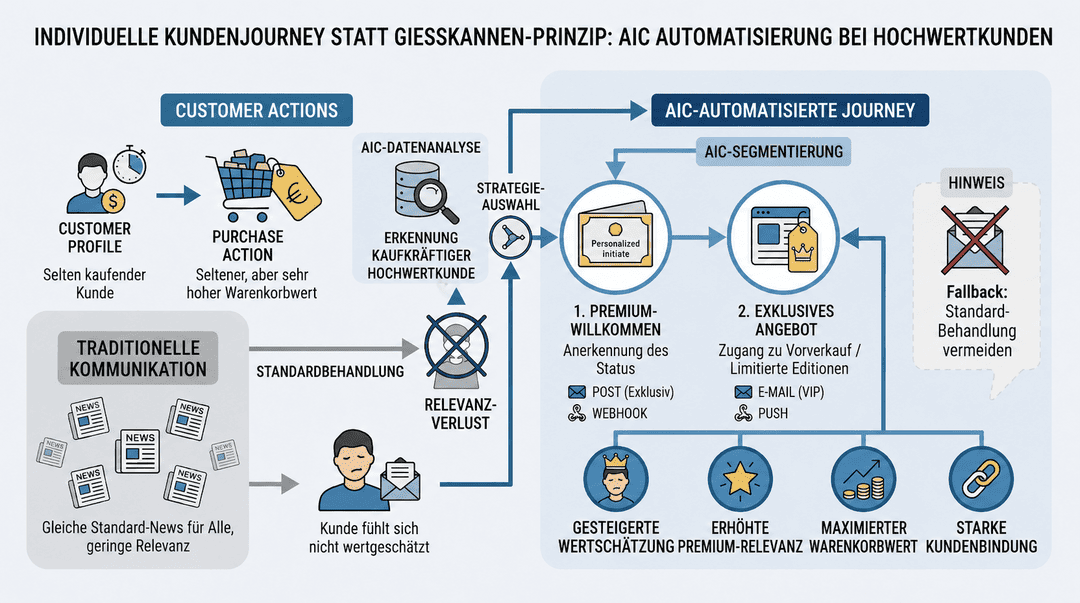
A specific example:
A customer buys rarely, but with a high basket value. Instead of treating them like a standard customer, you can address them in a targeted way with premium communication and exclusive offers.
AIC Group takes care not only of bringing the data together technically, but also of putting it to meaningful use in the marketing context.
More information on Customer Analytics: https://www.aicgroup.de/en/marketing-automation/#customer-analytics
18. HOW does a CDP improve segmentation and audience building?
Segmentation is the key to relevant communication. A CDP makes it possible to define target groups no longer statically, but dynamically and on the basis of data.
In the MAS, audiences are built via Customer Audiences, based on:
• behaviour (e.g. clicks, purchases, page visits)
• attributes (e.g. industry, revenue, region)
• events (e.g. sign-up, purchase, inactivity)
Typical segments:
• customers who abandoned their basket
• frequent buyers vs. occasional buyers
• inactive customers
• prospects who have not yet bought
• existing customers with upselling potential
Without a CDP:
Segmentation is often static, manual and error-prone.
With a CDP:
Segmentation is automated, dynamic and continuously updated.
An example:
A customer moves automatically from the “prospect” segment to “existing customer” as soon as a purchase is made. Different campaigns are then triggered automatically.
This increases:
• relevance of the communication
• efficiency of the campaigns
• conversion rates
More information on Customer Audiences: https://www.aicgroup.de/en/marketing-automation/#customer-audiences
19. WHAT role do data quality and data maintenance play in the context of marketing automation?
Data quality is a critical success factor for marketing automation. Poor data leads directly to poor campaigns.
Typical problems include, for example:
• incomplete data records
• outdated information
• duplicates
• incorrect assignments
• inconsistent data formats
The consequences:
• the wrong target groups are addressed
• unsuitable content
• inefficient campaigns
• falling conversion
AIC Group therefore attaches great importance to:
• data cleansing and validation
• clear data structures
• defined data processes
• continuous quality assurance
In the MAS, data can be processed, enriched and updated automatically. This keeps the data base usable in the long term.
A practical example:
A customer is listed twice in the system. Without cleansing, they receive duplicate communication. A clean data structure prevents this.
More information on Customer Data Platform: https://www.aicgroup.de/en/marketing-automation/#data-platform
20. HOW does the CDP support data-driven decisions in marketing?
A CDP does not just deliver data – it makes insights possible that are relevant to decisions.
In combination with the analysis functions of the MAS, companies can:
• analyse customer behaviour
• assess campaign performance
• compare target groups
• identify trends
• derive forecasts
Typical questions::
• Which target group converts best?
• Which campaign delivers the highest ROI?
• Which customers are at risk of churning?
• Which products are often bought together?
Here AIC Group combines CDP, analytics and AI-supported decision logic (e.g. Next Best Offer).
Example:
A system recognises that customers often buy product B after product A. A cross-selling campaign is derived from this automatically.
This makes marketing:
• data-based instead of intuitive
• predictable instead of reactive
• scalable instead of manual
More information on Customer Insights: https://www.aicgroup.de/en/marketing-automation/#customer-insight-studio
21. HOW is data protection (GDPR) taken into account in a Customer Data Platform?
Data protection is a central component of every data-driven marketing strategy – particularly in Europe.
A CDP must ensure that:
• personal data is processed in compliance with the law
• consents are documented
• data is only used for permitted purposes
• erasure and information obligations are met
In the MAS from AIC Group, data protection requirements are taken into account systematically, for example through:Im MAS der AIC Group werden Datenschutzanforderungen systematisch berücksichtigt, beispielsweise durch:
• a clean consent logic
• transparent data storage
• controllable access rights
• traceable data processing
Typical challenges:
• different consent sources
• international data flows
• complex system landscapes
Here AIC provides support with experience from numerous projects and develops individual solutions that bring together technical requirements and the legal framework.
Important note:
The specific legal assessment is always carried out individually for each company and, where applicable, in coordination with data protection officers.
More information on the data platform: https://www.aicgroup.de/en/marketing-automation/#data-platform
22. WHICH typical challenges arise when introducing a CDP?
Introducing a CDP is a strategic project that covers both technical and organisational aspects.
Typical challenges are, for example:
• heterogeneous system landscapes
• a missing data structure
• unclear definition of goals
• internal coordination problems
• a lack of resources
• high complexity of integrations
A common mistake:
Starting directly with technology without defining clear use cases or target pictures.
AIC Group therefore follows a structured approach:
• definition of specific use cases
• building a sensible data architecture
• step-by-step integration of systems
• quick delivery of first added value
From our many years of experience in particular, we know that a pragmatic start with clear goals is considerably more successful than an overly complex big-bang approach.
More information on Marketing Automation: https://www.aicgroup.de/en/marketing-automation/
23. HOW do you get started with a data-driven marketing strategy using a CDP?
Getting started with a data-driven marketing strategy does not have to be complex – what matters is a clear, practice-oriented approach.
Typical steps are:
1. Definition of specific use cases (e.g. abandoned baskets, reactivation)
2. Identification of relevant data sources
3. Building a central data base
4. first segmentations and target groups
5. Implementation of automated campaigns
6. continuous analysis and optimisation
AIC Group supports companies in this end to end – from strategy through technical implementation to operational use.
A typical start:
A company starts with a simple trigger campaign. After the first successes, further use cases are added and the data base is extended step by step.
Even when certain requirements are not fully covered by the standard, AIC develops suitable solutions – from integration to customisation.
The goal:
A scalable, future-proof marketing setup that grows with the company.
More information on Customer Data Platform: https://www.aicgroup.de/en/marketing-automation/#data-platform
If you have further questions about data integration & Customer Data Platform (CDP), please write to us using contact form. We look forward to your message!
Customer Audiences & segmentation
24. WHAT is meant by target groups in marketing?
Target groups in marketing are defined groups of people or companies that are to be addressed specifically with marketing measures. They form the basis of every successful marketing strategy.
In the context of AIC Group and the Marketing Automation Studio (MAS), however, target groups go far beyond static definitions. Here we speak of dynamic Customer Audiences, which arise automatically on the basis of data, behaviour and events and develop continuously.
Typical target groups can be, for example:
• new customers and prospects
• active existing customers
• inactive customers or customers at risk of churning
• frequent buyers or high-value customers
Typical challenges are, for example:
• target group definitions that are too broad
• a lack of differentiation
• static lists that are not updated
• low relevance in the way customers are addressed
With the MAS, AIC Group makes data-driven, dynamic audience building possible, which is transferred directly into automated campaigns.
More information on Customer Audiences: https://www.aicgroup.de/en/marketing-automation/#customer-audiences
25. WHY is audience building so important for successful marketing?
Audience building is crucial because it forms the basis for relevant, personalised and effective communication. Without clear target groups, the result is wasted coverage and inefficient campaigns.
In data-driven marketing – as AIC Group implements it with the MAS – audience building makes possible:
• more precise targeting
• higher relevance
• better conversion rates
• more efficient use of marketing budgets
Typical problems without clear target groups:
• the same content for all recipients
• low open and click rates
• low customer loyalty
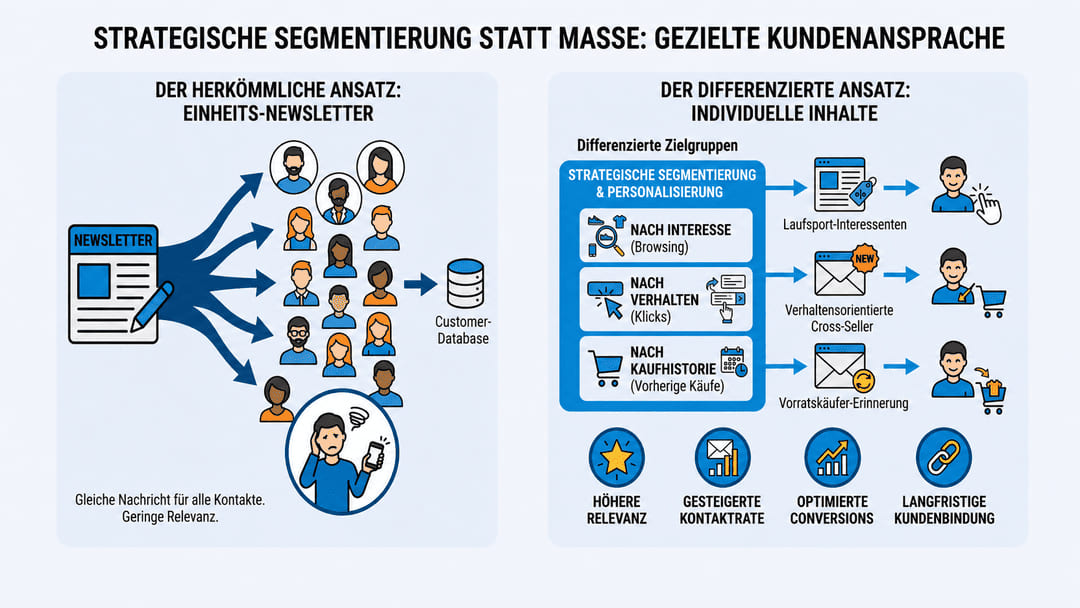
An example:
A company sends the same newsletter to all contacts. With differentiated target groups, individual content can be delivered instead, depending on interest, behaviour or purchase history.
Here AIC Group contributes experience from more than 25 years of data-driven marketing and develops target group strategies that contribute directly to specific business goals.
More information on personalisation: https://www.aicgroup.de/en/marketing-automation/#personalisierung
26. WHICH types of target groups are there in marketing?
In marketing there are different types of target groups, which are distinguished according to data base and strategy.
These include, for example:
1. Demographic target groups
• Age, gender, industry, company size
2. Geographic target groups
• Region, country, location
3. Behaviour-based target groups
• Website usage
• Click behaviour
• Purchasing behaviour
4. Psychographic target groups
• Interests, attitudes, preferences
5. Value-based target groups
• Revenue, purchase frequency, customer value
In the MAS from AIC Group, these approaches are combined to form highly precise Customer Audiences.
An example:
“All customers from industry X who have viewed product category Y in the last 30 days but have not bought.”
This allows a much more targeted way of addressing customers than classic segmentation.
More information on Customer Data Platform: https://www.aicgroup.de/en/marketing-automation/#data-platform
27. WHAT is segmentation in marketing?
Segmentation describes the process of dividing an overall target group into smaller, homogeneous subgroups so that they can be addressed in a targeted way.
In modern marketing, segmentation is a central success factor, particularly in combination with marketing automation.
In the MAS, segmentation is:
• data-based
• rule-driven
• dynamic
Typical segments are, for example:
• New customers vs. existing customers
• Active vs. inactive users
• Buyers of certain product categories
• Customers with high revenue potential
The advantage:
Each target group can be addressed with a fitting message.
AIC Group links segmentation directly with automation and personalisation – the result is not isolated data structures but marketing logic that can be used straight away.
More information on Customer Audiences: https://www.aicgroup.de/en/marketing-automation/#customer-audiences
28. HOW does segmentation work in practice?
In practice, segmentation is done by combining different data points and rules.
In the MAS, target groups are formed like this, for example:
• Selection of relevant criteria (behaviour, purchase, attributes)
• Definition of rules
• Automatic updating of the segments
Typical examples:
• “Customers with a purchase in the last 30 days”
• “Users with no activity for 90 days”
• “Prospects for product category X”
A concrete use case:
A customer visits a product page several times but does not buy. They are automatically placed in a segment “interested, but no purchase” and receive a fitting campaign.
Typical challenges:
• Segmentation rules that are too complex
• A missing data base
• Manual maintenance
AIC Group provides a clear, scalable segmentation logic that can be transferred directly into campaigns.
More information on Customer Insights: https://www.aicgroup.de/en/marketing-automation/#customer-insight-studio
29. WHAT is dynamic segmentation?
Dynamic segmentation means that target groups update automatically as soon as data or behaviour changes.
Unlike static lists, customers are continuously re-evaluated and assigned to the fitting segments.
In the MAS, this works through:
• Real-time data processing
• Rule-based logic
• Event triggers
Typical examples:
• Customer makes a purchase → moves to “existing customer”
• Customer becomes inactive → moves to “reactivation”
• Customer reaches a revenue threshold → high-value segment
The advantage:
• Target groups that are always up to date
• No manual maintenance
• Higher relevance
AIC Group uses dynamic segmentation as the basis for automated campaigns and customer journeys.
More information on Automation Workflow: https://www.aicgroup.de/en/marketing-automation/#automation-workflow
30. WHICH challenges are there in segmentation?
Segmentation also brings challenges, particularly as data complexity increases.
Typical challenges are, for example:
• Incomplete or poor data quality
• Too many segments without a clear use
• A lack of strategic direction
• Manual processes
• Complex system landscapes
A common mistake:
Segmentation is set up but not actively used.
AIC Group therefore takes a practical approach:
• Focus on relevant use cases
• Clear definition of goals
• Direct link to campaigns
For complex requirements, too, we develop individual solutions – from data integration to segmentation logic.
More information on Marketing Automation: https://www.aicgroup.de/en/marketing-automation/
31. HOW can target groups be used effectively?
Target groups only deliver their value when they are actively used in marketing activities.
In the MAS, target groups are used directly for:
• Automated campaigns
• Personalised content
• Customer journeys
• Cross-channel communication
Typical use cases:
• Personalised newsletters
• Trigger campaigns
• Product recommendations
• Reactivation measures
An example:
A customer is segmented as “inactive” → an automated reactivation campaign is triggered.
AIC Group makes sure that target groups do not exist in isolation but are turned directly into value creation.
More information on Automation Workflow: https://www.aicgroup.de/en/marketing-automation/#automation-workflow
32. HOW does AIC Group support companies with their target group strategy?
AIC Group supports companies end to end in developing and implementing their target group strategy.
Our approach covers:
• Analysis of the existing data base
• Definition of relevant target groups
• Building segmentation logic
• Implementation in the Marketing Automation Studio (MAS)
• Continuous optimisation
We bring in experience from more than 25 years of marketing, data strategy and automation.
Particularly important:
We always think of target groups in the context of:
• Customer journey
• Campaigns
• Business goals
For individual requirements or complex system landscapes, too, we develop fitting solutions – flexible and scalable.
More information on AIC Group: https://www.aicgroup.de/en/
If you have further questions about Customer Audiences & segmentation, please write to us using our contact form. We look forward to your message!
Automation Workflows & campaign management
33. HOW does marketing automation work in practice?
In practice, marketing automation is based on the interplay of data, target groups and automated processes.
In the MAS, this typically runs as follows:
1. Data is collected in the CDP
2. Target groups (Customer Audiences) are formed
3. Triggers define the starting point
4. Workflows control the communication
5. Content is delivered in personalised form
A typical sequence:
A user registers → is automatically assigned to a target group → receives a welcome email → further measures follow on interaction.
Typical use cases:
• Lead nurturing
• Abandoned basket campaigns
• Reactivation
• Communication with existing customers
AIC Group makes sure that these processes not only work technically but are also set up in a way that makes strategic sense.
More information on Automation Workflow: https://www.aicgroup.de/en/marketing-automation/#automation-workflow
34. WHAT are Automation Workflows?
Automation Workflows are defined, automated sequences that control marketing activities.
They determine:
• when an action is triggered
• which target group is addressed
• which content is delivered
In the MAS, workflows are the central control element for campaigns.
A workflow typically consists of:
• Trigger
• Conditions
• Actions
• Timing
Typical examples:
• Welcome series
• Reminder campaigns
• Reactivation processes
AIC Group uses workflows to develop concrete, automated measures from target groups.
More information on Automation Workflow: https://www.aicgroup.de/en/marketing-automation/#automation-workflow
35. WHEN is a campaign enough, and when do you need an Automation Workflow?
The MAS offers both. With Campaigns you implement simple, rule-based campaigns: one target group, one fixed point in time, one message – for example the monthly newsletter or a seasonal promotion.
An Automation Workflow, by contrast, controls multi-step sequences that respond to the behaviour of individual customers: an event starts the sequence, conditions branch the path, waiting times set the pace.
As a rule of thumb: the same message for everyone on a fixed date – campaign. A course that depends on the customer’s reaction – workflow. Both modules work on the same data base and with the same target groups.
More information on Automation Workflow: https://www.aicgroup.de/en/marketing-automation/#automation-workflow
36. HOW are Automation Workflows built?
Automation Workflows are built in a structured way and are based on clearly defined use cases.
Typical steps:
1. Definition of the goal (e.g. conversion, reactivation)
Selection of the target group
3. Definition of the trigger
4. Building the workflow logic
5. Integration of content
6. Testing and optimisation
Typical elements:
• If/else branches
• Waiting times
• Multi-step communicatio
An example:
A customer abandons a purchase → reminder after 24 hours → offer after 48 hours → completion or exit.
AIC Group develops workflows that are practical and scalable – matched to the structure of the company in question.
More information on Customer Audiences: https://www.aicgroup.de/en/marketing-automation/#customer-audiences
37. WHICH triggers are used in marketing automation?
Triggers are events that start a workflow.
Typical triggers are, for example:
Event-based triggers
• Registration
• Purchase
• Basket abandonment
Behaviour-based triggers
• Website visit
• Click behaviour
Time-based triggers
• Birthday
• Inactivity
Data-based triggers
• Segment change
• Status changes
An example:
A customer visits a product page several times → automatic trigger → targeted campaign.
AIC Group helps you select meaningful triggers that deliver real added value.
More information on Automation Workflow: https://www.aicgroup.de/en/marketing-automation/#automation-workflow
38. HOW does AIC Group support companies with marketing automation?
AIC Group supports companies end to end in introducing and optimising marketing automation.
Our approach covers:
• Strategy development
• Data integration
• Building target groups
• Workflow development
• Campaign management
• Analysis and optimisation
We bring in experience from more than 25 years of marketing, data and automation.
Particularly important:
We connect technology with concrete business goals and develop solutions that deliver measurable results.
For complex requirements or individual system landscapes, too, we offer tailor-made solutions..
More information on AIC Group: https://www.aicgroup.de/en/
If you have further questions about Automation Workflows & campaign management, please write to us using our contact form. We look forward to your message!
Content creation & personalisation
39. WHAT is meant by content in marketing?
Content in marketing covers everything that is used to communicate with customers – e.g. texts, images, offers, product information or campaign messages.
In modern marketing, however, content goes far beyond the material itself. What matters is how relevant, personalised and context-related the delivery of content is
In the Marketing Automation Studio (MAS) from AIC Group, content is understood as an integral part of the customer journey:
• specific to the target group
• data-driven
• delivered automatically
Typical content formats are, for example:
• Email campaigns
• Product offers
• Personalised recommendations
• Information and service communication
Typical challenges are, for example:
• Generic content without relevance
• High manual effort
• A lack of personalisation
• Inconsistent communication
AIC Group links content directly with data, target groups and automation – the result is relevant communication instead of mass messaging.
More information on Content Creation: https://www.aicgroup.de/en/marketing-automation/#content-creation
40. WHY is personalised content so important?
Personalised content is decisive because customers today expect to be addressed in a relevant and individual way. Standardised mass communication, by contrast, leads to falling attention and little effect.
Personalisation enables:
• Higher relevance
• Better customer loyalty
• Rising conversion rates
Typical examples:
• Individual product recommendations
• Personalised offers
• Content specific to the target group
An example:
A customer is interested in a certain product category. Instead of general advertising, they receive fitting, targeted offers.
Typical effects:
• Higher open rates
• Better click figures
• More revenue
AIC Group uses data-driven personalisation in the MAS to match content exactly to customer needs – based on behaviour, data and forecasts.
More information on personalisation: https://www.aicgroup.de/en/marketing-automation/#personalisierung
41. WHICH types of content are there in marketing?
Content in marketing can be divided into different categories.
These include, for example:
1. Informational content
• Newsletters
• Blog articles
• Product information
2. Sales-oriented content
• Offers
• Promotions
• Campaigns
3. Service content
• Order confirmations
• Status updates
• Support information
4. Personalised content
• Individual recommendations
• Personalised customer communication
In the MAS from AIC Group, these types of content are combined and used in a targeted way along the customer journey.
An example:
After a purchase, a customer receives both service information and fitting product recommendations.
More information on Content Creation: https://www.aicgroup.de/en/marketing-automation/#content-creation
42. HOW can content be created efficiently?
Efficient content creation is based on structure, reusability and automation.
In the MAS, AIC Group supports this through:
• Template-based creation
• Modular content building blocks
• Central management of content
• Automated delivery
Typical advantages:
• Less effort
• Faster implementation
• Consistent quality
An example:
A company uses a template for newsletters and adapts only individual pieces of content – instead of creating every mailing from scratch.
AIC Group helps to standardise content processes and keep them flexible at the same time.
More information on Content Creation: https://www.aicgroup.de/en/marketing-automation/#content-creation
43. HOW can content be combined with marketing automation?
Content only has its full effect in combination with marketing automation.
In the MAS, content is integrated directly into workflows:
• The target group is defined
• A trigger starts the campaign
• Content is delivered automatically
Typical use cases:
• Welcome series
• Reactivation campaigns
• Product recommendations
An example:
A customer registers → automatically receives relevant content → is developed further step by step.
AIC Group connects content, data and automation into one end-to-end system.
More information on Automation Workflow: https://www.aicgroup.de/en/marketing-automation/#automation-workflow
44. WHICH role does content play in the customer journey?
Content accompanies the customer along the entire customer journey.
Typical phases:
• Awareness (information)
• Consideration (interest)
• Conversion (purchase)
• Retention (loyalty)
Different content is relevant in each phase.
Examples:
• Informational content at the start
• Offers before the purchase
• Service content after the purchase
In the MAS, content is delivered in a targeted way along these phases.
AIC Group makes sure that content always fits the customer’s current situation.
More information on customer journey: https://www.aicgroup.de/en/marketing-automation/
45. HOW can content be personalised?
Content can be personalised in different ways.
These include, for example:
• Addressing the customer personally
• Individual content
• Dynamic building blocks
• Product recommendations
In the MAS, personalisation is based on:
• Data
• Behaviour
• Segmentation
• AI logic
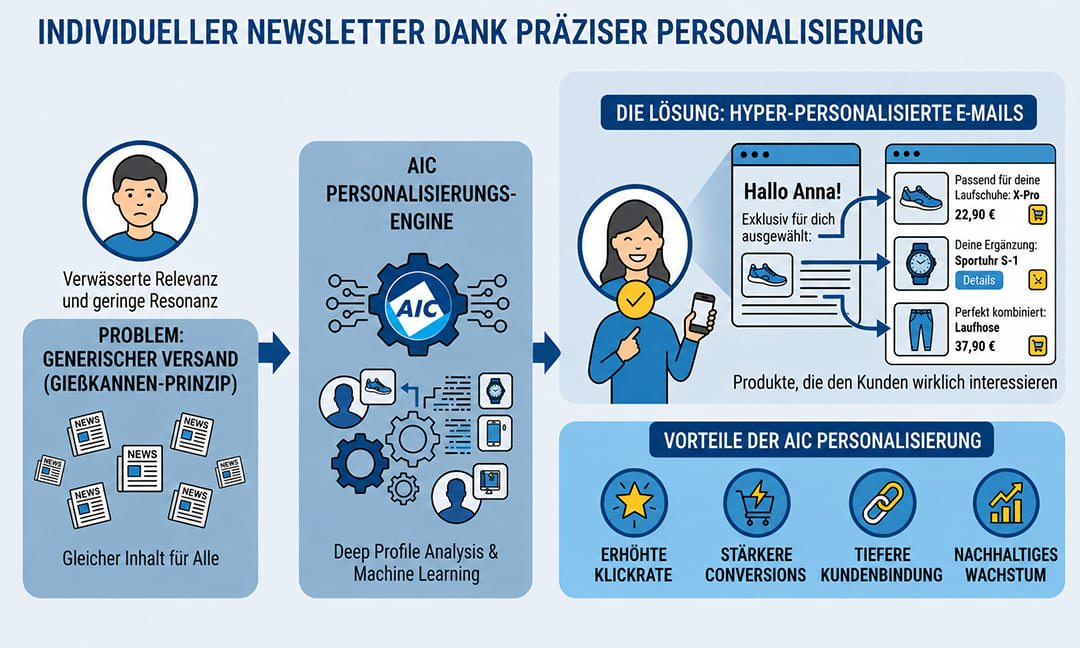
An example:
In the newsletter, a customer sees exactly the products that interest them.
AIC Group uses advanced methods to implement personalisation in a scalable way.
More information on personalisation: https://www.aicgroup.de/en/marketing-automation/#personalisierung
46. WHICH challenges are there in content creation?
Content creation brings various challenges.
Typical challenges are, for example:
• High time expenditure
• A lack of resources
• Insufficient personalisation
• Inconsistent content
• A missing strategy
A common mistake:
Content is created without a clear target group or use case.
AIC Group supports companies in:
• planning content strategically
• structuring processes
• implementing personalisation
For complex requirements, too, we develop fitting solutions.
More information on Marketing Automation: https://www.aicgroup.de/en/marketing-automation/
47. HOW does AIC Group support companies with content and personalisation?
AIC Group supports companies end to end with content creation and personalisation.
Our approach covers:
• Development of content strategies
• Building templates and structures
• Integration into Automation Workflows
• Implementation of personalised content
• Continuous optimisation
We bring in experience from more than 25 years of marketing, data and automation.
Particularly important:
We do not connect content in isolation, but always with:
• Data
• Target groups
• Campaigns
The result is relevant, scalable and effective customer communication.
More information on AIC Group: https://www.aicgroup.de/en/
If you have further questions about content creation & personalisation, please write to us using our contact form. We look forward to your message!
Cross-channel & delivery
48. WHAT is meant by Cross-Channel Marketing?
Cross-Channel Marketing describes the coordinated use of different communication channels to address customers consistently and in a coordinated way.
The aim is to reach the customer across several touchpoints – with a uniform message and coordinated content.
In the Marketing Automation Studio (MAS) from AIC Group, Cross-Channel Marketing is understood as an integral part of the customer journey:
• across channels
• data-driven
• controlled automatically
Typical channels include:
• email
• mobile push
• webhooks, through which connected systems are addressed
Typical challenges include:
• isolated channels
• inconsistent messages
• a lack of coordination
AIC Group makes sure that all channels are controlled centrally and interlinked.
More information on Cross-Channel Marketing: https://www.aicgroup.de/en/marketing-automation/
49. WHY is Cross-Channel Marketing so important today?
Today, customers move between different channels as a matter of course. They expect consistent and relevant communication – regardless of the touchpoint.
Cross-Channel Marketing is important because it:
• increases reach
• improves the customer experience
• increases conversion
• reduces media breaks
An example:
A customer does not open an email → and receives a push message or a reminder via another channel instead.
Typical problems without cross-channel:
• contradictory communication
• customers being addressed twice
• a lack of relevance
AIC Group uses the MAS to control cross-channel communication intelligently and to coordinate it in the best possible way.
More information on the customer journey: https://www.aicgroup.de/en/marketing-automation/
50. WHICH channels can be used in Cross-Channel Marketing?
In Cross-Channel Marketing, different channels can be combined with one another.
These include, for example:
• email
• mobile push
• webhooks, through which connected systems are addressed
In the MAS, these channels are controlled centrally and integrated into Automation Workflows.
A typical use case:
• an email is sent
• no response → push message
• still no response → reminder
AIC Group develops individual channel strategies – tailored to target groups, industry and business model.
More information on marketing automation: https://www.aicgroup.de/en/marketing-automation/
51. HOW does cross-channel campaign management work?
Cross-channel campaign management means that all measures are planned, controlled and evaluated centrally.
In the MAS, this is done via Automation Workflows:
• one workflow controls several channels
• content is delivered in a coordinated way
• responses are taken into account
Typical elements:
• sequences of channels
• dependencies (e.g. “if no response…”)
• dynamic adjustments
An example:
A customer receives an email → does not click → and after 24 hours is addressed in an alternative way via another channel.
AIC Group makes sure that this logic is set up cleanly and used in a strategically sensible way.
More information on Automation Workflow: https://www.aicgroup.de/en/marketing-automation/#automation-workflow
52. HOW can content be kept consistent across channels?
Consistency is a central success factor in Cross-Channel Marketing.
That means:
• the same message across all channels
• coordinated content
• a uniform tone of voice
In the MAS, this is supported by:
• central content management
• modular content building blocks
• uniform templates
Typical challenges:
• different teams
• different systems
• a lack of coordination
An example:
A customer receives the same campaign via different channels – adapted to each channel, but with an identical core message.
AIC Group supports companies in connecting content strategy and channel strategy.
More information on content creation: https://www.aicgroup.de/en/marketing-automation/#content-creation
53. WHICH challenges are there in Cross-Channel Marketing?
Cross-Channel Marketing also brings challenges with it.
Typical challenges include:
• a lack of integration between systems
• inconsistent data
• unclear responsibilities
• complex coordination processes
A common mistake:
Channels are controlled separately from one another.
AIC Group solves these challenges through:
• a central platform (MAS)
• an integrated data base
• a clear process structure
We also develop individual solutions for complex system landscapes.
More information on marketing automation: https://www.aicgroup.de/en/marketing-automation/
54. HOW does AIC Group support companies with Cross-Channel Marketing?
AIC Group supports companies end to end in setting up and optimising Cross-Channel Marketing.
Our approach covers:
• analysis of existing channels
• development of a cross-channel strategy
• integration into the Marketing Automation Studio (MAS)
• implementation of automated campaigns
• continuous optimisation
We bring in experience from more than 25 years of marketing, data integration and automation.
Particularly important:
We make sure that all channels do not work in isolation, but as part of a customer journey as a whole.
We also develop flexible and scalable solutions for individual requirements.
More information on AIC Group: https://www.aicgroup.de/en/
If you have further questions about cross-channel & delivery, please write to us using our contact form. We look forward to your message!
Analytics, reporting & AI / predictive analytics
(The Easy Way to a Modern Marketing Platform)
55. WHAT is meant by marketing analytics?
Marketing analytics covers the systematic evaluation of marketing data in order to measure, understand and optimise the effect of measures.
The aim is to make data-based decisions and to improve marketing continuously.
In the Marketing Automation Studio (MAS) from AIC Group, marketing analytics is an integral
part of the platform:
• analysis of campaign performance
• evaluation of customer behaviour
• identification of potential for optimisation
Typical metrics include:
• open rates
• click rates
• conversion rates
• revenue contributions
Typical challenges include:
• an insufficient data foundation
• isolated reports
• a lack of transparency
AIC Group links analytics directly to operational measures – the result is measurable outcomes rather than evaluations alone.
More information on Customer Analytics: https://www.aicgroup.de/en/marketing-automation/#customer-analytics
56. WHICH metrics are particularly relevant in marketing?
In marketing there are numerous metrics that are relevant depending on the objective.
These include, for example:
Performance metrics
• open rate
• click rate
• conversion rate
Financial metrics
• revenue
• contribution margin
• ROI
Customer-related metrics
• customer value
• repurchase rate
• churn rate
An example:
A campaign with a high open rate but low conversion shows potential for optimisation in the content or the offer.
In the MAS, these metrics are recorded and evaluated centrally.
AIC Group supports companies in defining the right KPIs and using them sensibly.
More information on Customer Analytics: https://www.aicgroup.de/en/marketing-automation/#customer-analytics
57. HOW does reporting work in the Marketing Automation Studio?
Reporting in the MAS is central and integrated – all relevant data is brought together in one platform.
Typical functions:
• dashboards
• campaign evaluations
• target group analyses
• performance reports
The advantage:
• no data silos
• fast evaluation
• a clear basis for decisions
An example:
A marketing team sees at a glance which campaigns are successful and where there is a need for optimisation.
AIC Group makes sure that reporting does not just deliver data, but makes concrete recommendations for action possible.
More information on Customer Analytics: https://www.aicgroup.de/en/marketing-automation/#customer-analytics
58. HOW can campaigns be optimised on the basis of data?
Campaigns are optimised through continuous analysis and adjustment.
Typical methods:
• target group comparisons
• adjustment of content
An example:
A campaign achieves many opens but hardly any purchases → the offer and content are adjusted for the next wave.
In the MAS, this optimisation is data-based.
AIC Group supports companies in implementing optimisation systematically.
More information on marketing automation: https://www.aicgroup.de/en/marketing-automation/
59. WHAT is predictive analytics in marketing?
Predictive analytics uses data and algorithms to predict future developments.
In marketing, that means:
• predicting customer behaviour
• identifying purchase probabilities
• forecasting churn
In the MAS from AIC Group, predictive analytics is used to:
• target campaigns more precisely
• optimise offers
• automate decisions
An example:
The system recognises which customer is highly likely to buy – and delivers a targeted offer.
More information on Customer Insights: https://www.aicgroup.de/en/marketing-automation/#customer-insight-studio
60. HOW does AI work in the context of marketing automation?
Artificial intelligence extends classic marketing automation with intelligent decision logic.
In the MAS, AI is used for:
• Next Best Offer
• product recommendations
• optimising segmentation
• forecasts
That means:
Systems make data-based decisions automatically.
An example:
A customer automatically receives the offer with the highest probability of success.
AIC Group uses AI specifically where it creates real added value – not as an end in itself.
More information on Customer Insights: https://www.aicgroup.de/en/marketing-automation/#customer-insight-studio
61. WHAT is Next Best Offer (NBO)?
Next Best Offer describes the logic of making a customer exactly the offer that is highly likely to be relevant and successful.
In the MAS, NBO is calculated on the basis of:
• customer data
• behaviour
• purchase history
• forecasts.
Typical advantages:
• higher conversion
• a better customer experience
• more efficient campaigns
An example:
A customer does not receive just any offer, but the one that suits them best individually.
AIC Group uses NBO as part of its AI-supported decision logic.
More information on personalisation: https://www.aicgroup.de/en/marketing-automation/#personalisierung
62. HOW can companies measure their marketing performance?
Marketing performance is measured by combining different metrics and analyses.
Typical approaches:
• campaign analysis
• ROI calculation
• target group comparisons
• customer journey analysis
An example:
A campaign is assessed not only by clicks, but by actual revenue.
In the MAS, these analyses are carried out centrally.
AIC Group supports companies in looking at performance as a whole.
More information on Customer Analytics: https://www.aicgroup.de/en/marketing-automation/#customer-analytics
63. WHICH challenges are there in analytics and AI?
Analytics and AI also bring challenges with them.
Typical challenges include:
• insufficient data quality
• a lack of data integration
• complex models
• a lack of expertise
A common mistake:
AI is used without a clear objective.
AIC Group therefore takes a pragmatic approach:
• clear use cases
• a clean data base
• step-by-step introduction
We also develop individual solutions for complex requirements.
More information on marketing automation: https://www.aicgroup.de/en/marketing-automation/
64. HOW does AIC Group support companies with analytics and AI?
In the Marketing Automation Studio (MAS), AIC Group links evaluation and implementation: what the analysis shows flows directly back into target groups and campaigns.
Our approach covers:
• defining the metrics by which success can be measured
• building the data base in the Customer Data Platform
• dashboards and evaluations with Customer Analytics
• AI-supported recommendations such as Next Best Offer – where there is a clear use case
• continuous optimisation based on the results
We bring in experience from more than 25 years of data integration, business intelligence and marketing automation.
Particularly important: we see AI as support for decisions – not as a black box or autopilot.
More information on Customer Analytics: https://www.aicgroup.de/en/marketing-automation/#customer-analytics
If you have further questions about analytics, reporting & AI / predictive analytics, please write to us using our contact form. We look forward to your message!
Strategy, introduction & project delivery
65. HOW do you get started with marketing automation?
Getting started with marketing automation does not begin with technology, but with a clear strategy.
Typical first steps are:
1. Defining concrete goals (e.g. conversion, customer loyalty)
2. Identifying relevant use cases
3. Analysing existing data and systems
4. Building an initial data base
5. Implementing the first automated campaigns
A typical start:
• abandoned basket campaign
• welcome series
• reactivation of inactive customers
AIC Group takes a pragmatic approach here:
create added value quickly and then expand systematically.
We also develop suitable solutions for individual requirements.
More information on marketing automation: https://www.aicgroup.de/en/marketing-automation/
66. WHICH requirements do companies have to meet?
Companies do not need a perfect starting position to get started with marketing automation.
Important requirements are, however:
• a basic data base
• a clear definition of goals
• willingness to change processes
• an understanding of data-driven marketing
Typical challenges include:
• fragmented data landscapes
• a lack of structure
• limited resources
AIC Group supports companies at exactly these points – from analysis to implementation.
Even if not all requirements are met, we develop individual strategies for getting started.
More information on Customer Data Platform: https://www.aicgroup.de/en/marketing-automation/#data-platform
67. HOW long does it take to introduce marketing automation?
The duration of the introduction depends heavily on the scope and complexity.
Typical time frames:
• first use cases: a few weeks
• medium-term build-up: several months
• full integration: individual
AIC Group deliberately takes an iterative approach:
• a quick start with first use cases
• step-by-step expansion
• continuous optimisation
An example:
A company starts with a reactivation campaign and then adds further processes step by step.
The advantage:
• quick results
• lower risk
• better scalability
More information on marketing automation: https://www.aicgroup.de/en/marketing-automation/
68. WHICH costs arise with marketing automation?
The costs of marketing automation are made up of various factors:
• software (e.g. MAS)
• implementation
• integration
• operation and optimisation
The investment depends on:
• company size
• complexity
• number of use cases
Important:
Marketing automation is not purely a cost centre, but an investment lever with measurable ROI.
An example:
An automated campaign generates additional revenue that clearly exceeds the investment.
AIC Group develops solutions that make economic sense and are scalable – for mid-sized companies and enterprise companies alike.
More information on Customer Analytics: https://www.aicgroup.de/en/marketing-automation/#customer-analytics
69. WHICH mistakes should companies avoid?
Typical mistakes often occur when marketing automation is introduced.
These include, for example:
• a lack of strategy
• too complex a start
• an unclear definition of goals
• poor data quality
• a lack of coordination between teams
A common mistake:
Technology is introduced without clear use cases.
AIC Group recommends:
• a focus on concrete use cases
• step-by-step build-up
• a clear objective
This way, risks can be minimised and quick successes achieved.
More information on marketing automation: https://www.aicgroup.de/en/marketing-automation/
70. HOW does a successful implementation work?
A successful implementation is based on a structured approach.
Typical success factors:
• a clear strategy
• a clean data base
• defined processes
• close coordination between specialist departments
• continuous optimisation
An example:
A company starts with a few clearly defined campaigns and expands them systematically.
AIC Group accompanies companies end to end – from strategy to operational implementation.
More information on Automation Workflow: https://www.aicgroup.de/en/marketing-automation/#automation-workflow
71. HOW can marketing automation be scaled?
Marketing automation can be scaled step by step.
Typical steps:
• expanding use cases
• integrating further data sources
• expanding target groups
• using additional channels
• using AI
An example:
A company starts with email automation and later expands to cross-channel and predictive analytics.
The MAS has a modular structure and grows with the requirements.
AIC Group makes sure that scaling is structured and sustainable.
More information on Customer Insights: https://www.aicgroup.de/en/marketing-automation/#customer-insight-studio
72. WHICH role does change management play?
Marketing automation is not just a technology project, but also a process of change.
Typical challenges:
• new ways of working
• new processes
• new roles
Important success factors:
• training of employees
• clear communication
• involvement of all stakeholders
AIC Group also supports companies in organisational change – not just technically.
More information on AIC Group: https://www.aicgroup.de/en/
73. HOW can the success of marketing automation be secured in the long term?
Long-term success comes from continuous further development.
Typical measures:
• regular analysis
• optimisation of campaigns
• extension of use cases
• use of new technologies
An example:
A campaign is reviewed and optimised regularly – instead of being implemented once.
AIC Group accompanies companies over the long term and ensures lasting success.
More information on Customer Analytics: https://www.aicgroup.de/en/marketing-automation/#customer-analytics
74. HOW does AIC Group differ from other providers?
AIC Group differs through an approach that looks at the whole:
• combination of technology, data and strategy
• own platform: Marketing Automation Studio (MAS)
• focus on customer engagement
• AI-supported decision support
Particularly worth highlighting:
• more than 25 years of experience
• projects with well-known companies from the German economy
• individual, flexible solutions
We see marketing automation not as a tool, but as a strategic success factor.
More information on AIC Group: https://www.aicgroup.de/en/
75. WHICH role does consulting play in marketing automation?
Consulting is a central success factor in marketing automation.
Why?
Because technology alone is not enough.
Typical consulting services:
• strategy development
• use case definition
• process design
• data strategy
AIC Group combines consulting and implementation – for end-to-end solutions.
We develop suitable concepts for complex requirements, too.
More information on AIC Group: https://www.aicgroup.de/en/
76. HOW does AIC Group support companies in the long term?
AIC Group accompanies companies across the entire life cycle:
• strategy
• implementation
• operation
• optimisation
Our approach:
• long-term partnership
• continuous further development
• measurable results
In doing so, we bring in our experience from more than 25 years of projects.
More information on AIC Group: https://www.aicgroup.de/en/
77. WHY is now the right time for marketing automation?
The right time is now, because:
• customers have high expectations
• data is available
• competition is increasing
• technologies are mature
Companies that invest now secure long-term competitive advantages.
AIC Group supports companies in taking this step successfully – in a structured, practical and scalable way.
More information on marketing automation: https://www.aicgroup.de/en/marketing-automation/
If you have further questions about strategy, introduction & project delivery, please write to us using our contact form. We look forward to your message!
FAQ SECTION: Agentic AI
Strategy, introduction & project delivery
78. WHAT is an AI agent and how does it differ from a chatbot?
A chatbot answers questions. An agent acts: it follows a defined role, accesses stored knowledge, uses tools and works through tasks. In short – generative AI answers, agentic AI acts.
More information on agentic AI: https://www.aicgroup.de/en/agentic-ai/
79. WHAT does agentic AI mean?
Agentic AI is the most recent layer of AI development, built on generative models and supplemented by knowledge, planning and tool use. For us, the term stands for agents that take expert load off employees – not for process automation.
More information on agentic AI: https://www.aicgroup.de/en/agentic-ai/
80. DOES an AI agent replace employees?
No – and that is not the aim either. Our agents take expert load off employees: they prepare, check, suggest and sometimes disagree. Decision and responsibility remain with people. An agent is a sparring partner, not an autopilot. How far it works independently over time is something you decide step by step.
More information on working with the agent: https://www.aicgroup.de/en/agentic-ai/#arbeiten-mit-agenten
81. WHAT does AIC Group itself use AI agents for?
For our own content planning. The agent knows our positioning, language rules and editorial planning and works out posts with us. It has been running in day-to-day work for months and is continuously refined. Our consulting offer grew out of this.
More information from practice: https://www.aicgroup.de/en/blog/
82. HOW does building an agent work?
In six phases: clarify role and goal, write the system prompt, build the knowledge base, develop skills, work with it in day-to-day business, optimise continuously. We describe each phase on our Agentic AI page.
More information on the six phases: https://www.aicgroup.de/en/agentic-ai/
83. WHICH prerequisites does a company need to meet?
Three questions are decisive earlier than any technology question: Is the required knowledge available in structured form? Can the task be described? Has it been clarified who checks and approves the output? A large IT project is not necessary.
More information on role & purpose: https://www.aicgroup.de/en/agentic-ai/#rolle-ziel
84. WHICH use case is suitable as a starting point?
A task that comes up regularly, whose knowledge is available in writing and whose result the users can judge for themselves. Without this judgement there is no feedback, and without feedback no improvement. Sensitive fields such as personnel selection are not suitable as a starting point.
More information on role & purpose: https://www.aicgroup.de/en/agentic-ai/#rolle-ziel
85. WHICH AI model is this tied to?
None. Our consulting is tool-agnostic. System prompt, knowledge files and skills are kept with you as readable files and still work if you change the model.
More information on agentic AI: https://www.aicgroup.de/en/agentic-ai/
86. WHAT does the EU AI Act have to do with this?
It regulates the use of AI by risk classes, and these depend on the intended purpose, not on the model. We classify the intended purpose pragmatically and anchor guard rails in the system prompt. This is not legal advice.
More information on the system prompt: https://www.aicgroup.de/en/agentic-ai/#system-prompt
If you have further questions about Agentic AI & AI agents, please write to us using our contact form. We look forward to your message!
FAQ SECTION: BI-Consulting & Analytics
Strategic foundations & benefits of business intelligence
87. WHAT does business intelligence (BI) mean and why is it becoming increasingly important for enterprise companies?
Business intelligence turns scattered data into a basis for decisions. Metrics are defined uniformly, data from different sources is brought together and prepared in such a way that specialists and managers can use it without a detour via IT.
It is becoming more important because data today comes from more and more systems and decisions have to be made faster. Without a shared data base, every department calculates with its own figures – and meetings revolve around the question of which figure is correct. BI creates structure here, reduces complexity and makes decisions possible.
More information on business intelligence: https://www.aicgroup.de/en/business-intelligence/
88. WHAT strategic benefit does business intelligence offer enterprise companies?
The strategic benefit is that steering is based on reliable figures instead of assumptions. Typical examples are:
• a shared definition of the most important metrics across all departments
• a quick view of deviations between plan and actual
• less manual effort for reports that are compiled in spreadsheets today
• specialists and managers who answer their questions themselves instead of waiting for analyses from IT
BI has the greatest leverage where it is aligned with concrete decisions. That is why we start with the questions and not with the data – advice before technology.
More information on Data Strategy: https://www.aicgroup.de/en/business-intelligence/#data-strategy
89. WHY are data-based decisions more successful than assessments based purely on experience?
Experience remains valuable – it tells you which questions are important. Data shows whether the answer is right.
Assessments based purely on experience reach their limits where relationships are too complex, markets too fast or developments gradual. Data-based decisions are traceable, can be verified and get better with every piece of feedback.
The combination of the two is strongest: specialists formulate the assumption, the data confirms or refutes it. BI provides the basis for this – uniformly defined metrics, a reliable data base and analyses that specialist departments can use themselves.
More information on Data Analytics: https://www.aicgroup.de/en/business-intelligence/#data-analytics
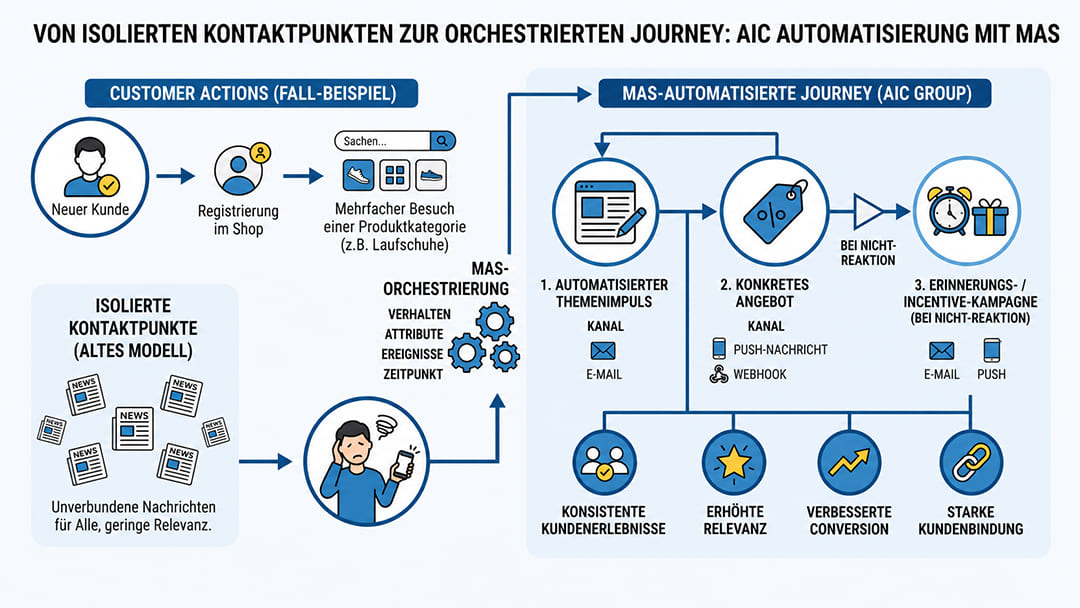
90. HOW does business intelligence support management, C-level and specialist departments in strategic decisions?
Each level needs a different view of the same figures. Management needs a few reliable steering metrics at a glance. Specialist departments need the depth behind them in order to understand causes and derive measures.
BI combines both on a shared data base:
• management dashboards with the central metrics
• the path from the overall view down to individual regions, products or cost centres
• reports that are available regularly and without manual effort
• self-service analyses for the specialist departments
This way, all levels talk about the same figures – and the discussion revolves around decisions instead of the question of which report is correct.
More information on Data Analytics: https://www.aicgroup.de/en/business-intelligence/#data-analytics
91. WHICH areas of a company benefit particularly from business intelligence?
Business intelligence delivers its greatest benefit wherever large volumes of data have to be translated into reliable decisions. In enterprise companies, this generally affects almost all central functions.
Those that benefit particularly strongly include, for example:
• Management & executive board: for strategic steering, goal tracking and performance transparency
• Controlling & finance: for KPI-based steering, reporting, budgeting and forecasting
• Sales: for revenue analyses, customer development, potential assessment and regional steering
• Marketing: for campaign evaluation, target group analyses and performance measurement
• Purchasing & supply chain: for inventory, demand and supply chain analyses
• Operations & production: for process optimisation, capacity utilisation steering and quality monitoring
• HR & service: for resource planning, service levels and operational transparency
AIC Group does not develop BI solutions on a one-size-fits-all basis, but tailored to role, area of responsibility and decision-making needs. The result is precisely fitting dashboards, dossiers and reports instead of generic standard analyses.
Our experience from more than 25 years of BI consulting shows: the greatest benefit arises when all areas work on a consistent data base and still receive exactly the views they need for their tasks.
More information on business intelligence: https://www.aicgroup.de/en/business-intelligence/
92. WHY does business intelligence create more transparency in the company?
In many enterprise companies, data has grown historically, is spread across numerous systems and is defined differently from department to department. The result is reports that deviate from one another, contradictory metrics and a high coordination effort between departments.
Business intelligence creates transparency by bringing relevant data sources together, standardising metrics and providing information in a uniform form. As a result, management and specialist departments access the same data base. This reduces room for interpretation and strengthens trust in figures and decisions.
AIC Group supports you at exactly this point with Data Integration, Data Design and KPI definition.
Typical challenges include, for example:
• several truths for the same metric
• manually maintained Excel reports in individual specialist departments
• a lack of continuity between operational systems and management reporting
• unclear data origin and a lack of traceability
• low acceptance of reports due to inconsistent results
A structured BI landscape creates traceable information flows, clear responsibilities and reliable bases for decisions. In large organisations in particular, transparency is not a nice-to-have, but a prerequisite for effective steering.
More information on Data Integration: https://www.aicgroup.de/en/business-intelligence/#data-integration
93. WIE HOW does business intelligence improve planning, forecasting and steering processes?
Planning and forecasting processes are only reliable if they are based on consistent, up-to-date and cleanly defined data. Business intelligence creates the basis for this by bringing together and analysing historical developments, current metrics and relevant influencing factors in a structured way.
This allows planning to be set up in a considerably more realistic and dynamic way.
Companies can, for example:
• assess revenue developments earlier
• analyse cost trends more transparently
• plan resources and capacities more precisely
• identify deviations between plan and actual more quickly
• continuously update and refine forecasts
AIC Group supports enterprise companies in setting up forecasting and steering processes in such a way that they are usable in operations and reliable strategically. This includes, for example, building tailored data models, defining the KPIs relevant for steering, integrating distributed data sources and implementing them in Strategy or Power BI dashboards.
In volatile markets in particular, reliable forecasts are a significant competitive advantage. Companies that steer their planning on the basis of data react faster to changes and can address risks considerably earlier.
More information on Data Analytics: https://www.aicgroup.de/en/business-intelligence/#data-analytics
94. WHAT is part of a data strategy?
Steering and planning processes, data and system architecture, roles and responsibilities, the system of metrics and the question of data governance. So considerably less technology than many expect.
More information on Data Strategy: https://www.aicgroup.de/en/business-intelligence/#data-strategy
If you have further questions about strategic foundations & benefits of business intelligence, please write to us using our contact form. We look forward to your message!
Data integration, data quality & data architecture
95. WHAT is meant by data integration in the context of business intelligence?
In the business intelligence context, data integration refers to the process in which data from different source systems is brought together, harmonised and made available for analysis purposes.
In enterprise companies, data typically comes from a large number of systems – for example ERP, CRM, finance, e-commerce, data warehouses or external data sources. Without structured data integration, this data remains isolated and can only be used to a limited extent for analyses of the business as a whole.
AIC Group supports companies in breaking down exactly these silos and creating a consistent data base.
This includes, for example:
• connection and integration of heterogeneous source systems
• standardisation of data structures and formats
• cleansing and transformation of raw data
• building high-performance data pipelines
• ensuring that data is consistent and up to date
With more than 25 years of experience in BI consulting, we develop scalable integration architectures that reliably map even complex enterprise landscapes – as the basis for meaningful analyses in Strategy and Power BI
More information on Data Integration: https://www.aicgroup.de/en/business-intelligence/#data-integration
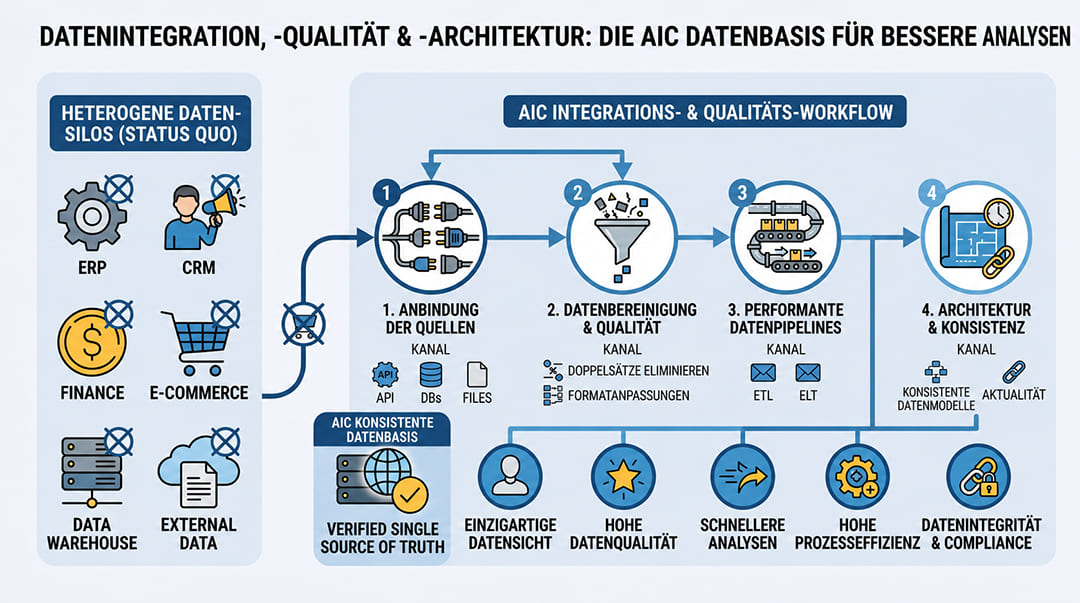
96. WHY is data quality decisive for the success of BI projects?
The quality of the data is the decisive success factor of every business intelligence solution. Even the most powerful tools such as Strategy or Power BI only deliver valid results if the underlying data is correct, complete and consistent.
In practice, typical challenges frequently appear, such as:
• incomplete or incorrect data records
• contradictory KPI definitions
• outdated or unsynchronised data sets
• a lack of standards for data maintenance and validation
• different interpretations of the same metric
AIC Group therefore places particular focus on data quality management as an integral part of every BI architecture. Together with our customers, we define clear data standards, establish validation processes and ensure transparent data origins.
In enterprise projects in particular, our experience shows: a clean data base decides whether BI is accepted as a strategic steering instrument or not.
More information on business intelligence: https://www.aicgroup.de/en/business-intelligence/
97. WHICH challenges arise when integrating data from different systems?
Integrating data from different systems is one of the most demanding tasks in the BI environment – especially in enterprise structures that have grown over time.
Typical challenges include:
• different data models and data formats
• missing unique keys for linking data records
• inconsistent master data across systems
• high data volumes and performance requirements
• complex system landscapes with many interfaces
• IT structures that have grown historically without clear documentation
AIC Group contributes its many years of project experience here and develops individual integration strategies that perform well technically and are consistent in business terms. This includes, for example, building central data warehouses, modern data lake architectures or hybrid approaches.
Our aim is not just to connect data technically, but to prepare it in business terms so that it can be used directly for analyses and decisions.
More information on data architecture: https://www.aicgroup.de/en/business-intelligence/#data-integration
98. WHAT is a data warehouse and what role does it play in the BI architecture?
A data warehouse is a central data platform in which structured, cleansed and historised data from different source systems is brought together. It forms the basis for consistent analyses, reports and dashboards in the business intelligence environment.
Unlike operational systems (e.g. ERP or CRM), a data warehouse is optimised specifically for analysis purposes.
It enables:
• a consolidated view of company-wide data
• historised evaluations and time series analyses
• stable, high-performance reporting structures
• a uniform definition of metrics and dimensions
AIC Group develops and implements data warehouse architectures that are tailored exactly to the requirements of enterprise companies. In doing so, we take both classic and modern approaches into account – from relational DWH systems to cloud-based architectures.
A cleanly built data warehouse is the central prerequisite for successful BI projects with Strategy or Power BI.
More information on data design: https://www.aicgroup.de/en/business-intelligence/#data-integration
99. WHAT role do data models play in the business intelligence environment?
Data models are the foundation of every BI solution. Facts, attributes, metrics and filters determine what can be analysed at all later on. A clean model saves you the discussion about which figure is actually correct.
A well thought-out data model ensures that metrics are calculated correctly, relationships are presented in a traceable way and analyses run with good performance.
Typical tasks in data modelling include:
• defining fact and dimension tables
• building star or snowflake schemas
• mapping business logic and KPI calculations
• ensuring consistency across all reports
• optimising for performance and scalability
AIC Group contributes extensive expertise from numerous enterprise projects here. We develop tailor-made data models that combine business requirements and technical conditions in the best possible way.
In complex organisations in particular, the quality of the data model decides whether BI solutions remain scalable and maintainable in the long term.
More information on data design: https://www.aicgroup.de/en/business-intelligence/#data-design
100. HOW can a scalable BI data architecture be built?
A scalable BI data architecture must be able to support growing data volumes, rising user numbers and new use cases flexibly – without performance or data quality suffering.
For enterprise companies, this means creating an architecture that is both stable and adaptable.
This includes, for example:
• clear separation of data integration, storage and analysis
• use of data warehouses and/or data lakes
• a modular, extensible system architecture
• high-performance data processing and load processes
• integration of cloud technologies and hybrid scenarios
• governance structures for data and access
AIC Group always develops BI architectures with long-term use and extensibility in mind. Our solutions are designed so that new data sources, additional business departments or new analysis requirements can be integrated at any time.
From more than 25 years of BI consulting, we know what matters in sustainable architectures – especially in complex enterprise environments.
More information on data architecture: https://www.aicgroup.de/en/business-intelligence/#data-integration
101. HOW do you make sure that BI systems keep performing well even with large data volumes?
The performance of BI systems is a critical success factor – especially in enterprise companies with large data volumes and many concurrent users.
High performance is not determined by the BI tool alone, but above all by the underlying data architecture, the data model and the integration processes.
Important measures include:
• optimised data models for fast queries
• aggregations and pre-calculations for frequently used metrics
• efficient load processes and data pipelines
• use of suitable storage technologies (e.g. in-memory)
• clear separation of operational and analytical systems
• monitoring and continuous performance optimisation
AIC Group treats performance as an integral part of every BI solution from the very beginning. In Strategy implementations in particular, we bring in-depth expertise to ensure stable, fast analyses even with very large data volumes.
The goal is always the same: users get reliable results within seconds – regardless of data volume and complexity.
More information on Strategy: https://www.aicgroup.de/en/strategy/
102. WHAT role does data governance play in the business intelligence environment?
Data governance covers all organisational, business and technical measures for managing, safeguarding and controlling data in the company. In the BI context, it is decisive for ensuring data quality, consistency and security in the long term.
In enterprise companies in particular, data governance is indispensable because many departments, systems and users access the same data. Without clear rules, inconsistencies and uncertainty arise quickly.
Typical components of a data governance strategy include:
• definition of uniform KPI and data standards
• clear responsibilities for data (data ownership)
• rules for data maintenance and data quality
• access concepts and authorisation structures
• documentation of data origins (data lineage)
• compliance and data protection requirements
AIC Group supports companies in building sustainable data governance structures that take both business requirements and the regulatory framework into account.
Even though data governance is often not the focus of the initial BI introduction, practice shows that it is decisive for the long-term success and acceptance of BI solutions.
More information on business intelligence: https://www.aicgroup.de/en/business-intelligence/
If you have further questions about data integration, data quality & data architecture, please write to us using our contact form. We look forward to your message!
BI tools, technologies & platforms
(Strategy & Power BI Focus)
103. WHICH business intelligence tools are particularly relevant for enterprise companies?
Enterprise companies mainly use scalable, powerful business intelligence platforms that can be integrated and that support complex data landscapes and large numbers of users.
The most relevant solutions include, for example:
• Strategy (formerly MicroStrategy): enterprise analytics platform for highly scalable, central BI architectures
• Microsoft Power BI: flexible self-service BI solution with strong integration into the Microsoft world
• Other providers: e.g. Tableau, SAP Analytics Cloud or Qlik
AIC Group specialises in Strategy and Power BI and supports companies in selecting the right platform for their requirements and implementing it in the best possible way.
Our approach is deliberately vendor-independent: we do not assess technologies in isolation, but always in the context of data strategy, architecture, use cases and organisational requirements.
With more than 25 years of BI experience, we know that the lasting success of a BI project does not depend primarily on the tool, but on how well it is integrated into the overall architecture and the business processes.
More information on business intelligence: https://www.aicgroup.de/en/business-intelligence/
104. WHAT is Strategy (formerly MicroStrategy) and what advantages does the platform offer?
Strategy is a powerful enterprise analytics platform developed specifically for large organisations with complex data structures and high requirements for scalability, security and performance.
The platform makes it possible to analyse company-wide data centrally, build standardised KPI systems and provide information in the form of dashboards, reports and mobile applications.
Typical advantages include:
• a central, consistent data base for the entire company
• high scalability for large data volumes and numbers of users
• powerful in-memory analyses
• extensive security and authorisation concepts
• mobile BI and analytical apps for different target groups
• strong governance and standardisation options
AIC Group has in-depth expertise in Strategy projects and accompanies companies from architecture through implementation to further development.
We see ourselves as experts for your Strategy project and its lasting success – especially in complex enterprise environments where standard solutions are not enough.
More information on Strategy: https://www.aicgroup.de/en/strategy/
105. WHAT is Microsoft Power BI and when does it make sense to use it?
Microsoft Power BI is a modern business intelligence platform that stands out in particular for its ease of use, flexibility and integration into existing Microsoft ecosystems.
Power BI enables business departments to analyse data independently, create interactive dashboards and share insights quickly. At the same time, the platform can also be embedded in enterprise architectures.
Using it makes particular sense when there is:
• a need for self-service BI for business departments
• heavy use of Microsoft technologies (e.g. Azure, Office 365)
• fast implementations and iterative projects
• decentralised analysis requirements
• a need to complement existing BI systems
AIC Group supports companies in using Power BI in a structured and scalable way – especially where self-service and governance have to be reconciled.
Typical challenges include:
• uncontrolled growth of reports (“sprawl”)
• inconsistent KPI definitions
• no central data base
• performance problems with large data volumes
We make sure that Power BI not only delivers added value quickly, but is also integrated into a sustainable BI strategy in the long term.
More information on business intelligence: https://www.aicgroup.de/en/business-intelligence/#data-analytics
106. WHAT are the differences between Strategy and Power BI?
Strategy (formerly MicroStrategy) and Power BI follow different approaches in the business intelligence environment and in many cases complement each other well.
The most important differences can be summarised as follows:
Strategy:
• focus on central, company-wide BI architectures
• strong governance and standardisation
• high scalability for large data volumes
• ideal for group-wide reporting and management control
Power BI:
• focus on self-service BI and flexible analyses
• fast creation of reports by business departments
• close integration into Microsoft products
• ideal for decentralised analyses and agile use cases
AIC Group advises companies on finding the right balance between central control and flexible use. In many enterprise scenarios, a combination of both approaches makes sense.
Our experience shows that successful BI landscapes do not come from tool decisions alone, but from a clear strategy, a clean data architecture and defined governance structures.
More information on BI strategy: https://www.aicgroup.de/en/business-intelligence/
107. WHEN should you use Strategy and Power BI in combination?
Combining Strategy and Power BI makes particular sense in enterprise companies that need both central control and flexible analyses.
A typical target picture is:
• Strategy as the central platform for standardised reporting, KPI systems and company-wide control
• Power BI as a complementary tool for self-service analyses and exploratory evaluations in business departments
Typical usage scenarios include:
• management uses standardised dashboards in Strategy
• business departments analyse detailed questions in Power BI
• the central data base is provided by a data warehouse
• governance and KPI logic are defined centrally
AIC Group develops exactly these hybrid BI architectures, which allow for both stability and flexibility.
We take particular care that no parallel data worlds emerge, and that both systems build on one consistent data base.
More information on data architecture: https://www.aicgroup.de/en/business-intelligence/#data-analytics
108. WHAT role do cloud technologies play in the modern BI environment?
Cloud technologies have fundamentally changed the business intelligence environment and offer enterprise companies new possibilities in terms of scalability, flexibility and speed.
Modern BI architectures use cloud platforms, for example, for:
• storing large data volumes (data lakes, cloud data warehouses)
• flexible computing power for analyses
• fast integration of new data sources
• global availability of BI applications
• cost-efficient scaling as needed
AIC Group supports companies in developing and implementing cloud-based and hybrid BI architectures – aligned with existing IT landscapes and strategic goals.
Typical challenges include:
• migrating existing systems to the cloud
• ensuring data protection and compliance
• integrating on-prem and cloud data
• cost control and resource management
Our experience shows that the cloud is not an end in itself, but a strategic tool that creates considerable added value when used correctly.
More information on business intelligence: https://www.aicgroup.de/en/business-intelligence/
109. HOW do you find the right BI platform for your own company?
Choosing the right BI platform is a strategic decision that goes far beyond technical aspects. In the long term, it influences the way management and business departments work as well as the entire data strategy.
Important criteria include:
• complexity of the existing system landscape
• data volume and scaling requirements
• need for central control vs. self-service
• security and governance requirements
• integration into existing technologies
• user groups and their requirements
AIC Group guides companies through this selection process in a structured way. We analyse requirements, assess suitable technologies and develop a target picture for the BI architecture.
In doing so, we draw on our experience from numerous projects with well-known companies in the German economy – from retail and financial services to utilities.
Our goal is not just to select a tool, but to establish a sustainable, future-proof BI solution.
More information on business intelligence: https://www.aicgroup.de/en/business-intelligence/
110. WHAT role does the usability of BI tools play in the enterprise environment?
The usability of BI tools is a decisive success factor – especially in large organisations with different user groups.
However powerful a BI system may be technically: if business departments do not accept or use it, the added value fails to materialise.
Important aspects of usability include:
• intuitive operation of dashboards and reports
• clear visualisation of metrics and relationships
• short loading times and responsive interactions
• information prepared for the specific target group
• simple options for your own analysis (self-service)
AIC Group attaches great importance to user-centred design and practical solutions. We develop dashboards not from a technical perspective, but from the point of view of the users and their decision-making processes.
Enterprise projects in particular show that high acceptance comes when BI solutions are easy to use and deliver real added value in everyday work.
More information on data analytics: https://www.aicgroup.de/en/business-intelligence/#data-analytics
If you have further questions about use cases & concrete BI applications, please write to us using our contact form. We look forward to your message!
Use cases & concrete BI applications
111. WHICH typical use cases are there for business intelligence in enterprise companies?
In enterprise companies, business intelligence is used in almost all central management and decision-making processes. The concrete benefit shows most clearly in practical use cases that contribute directly to business goals.
Typical use cases include:
• Making business decisions: management dashboards for assessing revenue, margin and profitability
• Sales management: analysis of customers, regions, products and sales channels
• Finance and controlling reports: planning, budgeting, forecasting and variance analyses
• Supply chain & logistics: inventory analyses, supply chain transparency and demand forecasts
• Marketing analyses: campaign evaluation, target group analysis and performance measurement
• Store and location analyses (retail): revenue development, footfall and assortment management
AIC Group supports enterprise companies in implementing exactly these use cases in a structured way – from the business concept and data integration to implementation in Strategy or Power BI.
Our experience from numerous projects with well-known German companies shows: the greatest added value arises when BI is consistently aligned with concrete business questions.
More information on business intelligence: https://www.aicgroup.de/en/business-intelligence/
112. HOW can business intelligence be used in sales?
In sales, business intelligence creates transparency about customers, revenue, products and sales activities – and so enables targeted management and optimisation.
Typical uses include:
• Analysis of revenue development by region, product and customer segment
• Identification of top and low performers in sales
• Assessment of sales channels and measures
• Detection of cross-selling and upselling potential
• Management of targets and sales activities
• Forecasting of sales volumes and revenue development
AIC Group develops tailor-made sales dashboards and analysis models that are matched exactly to the requirements of sales management and field sales.
Typical challenges include:
• lack of transparency about customer potential
• inconsistent sales metrics
• time-consuming manual evaluations
• insufficient data foundation for forecasts
With structured BI solutions, we create a reliable foundation for data-based sales decisions – at both the operational and the strategic level.
More information on Data Analytics: https://www.aicgroup.de/en/business-intelligence/#data-analytics
113. WHICH role does business intelligence play in controlling and finance?
In controlling and finance, business intelligence is a central instrument for managing company performance.
BI makes it possible to prepare financial metrics consistently, recognise developments early and make well-founded decisions.
Typical use cases include:
• Creation of finance and management reports
• Budget planning and forecasting
• Variance analyses (plan vs. actual)
• Cost and earnings analyses
• Liquidity and cash flow analyses
• Consolidation of data from different group companies
AIC Group supports companies in building integrated reporting and management systems that connect finance, controlling and management.
Particularly in complex company structures, it is crucial that everyone involved works from one uniform data base. Our experience from more than 25 years of BI consulting shows that this is often exactly where the greatest potential lies.
More information on business intelligence: https://www.aicgroup.de/en/business-intelligence/
114. HOW can business intelligence be used in marketing?
In marketing, business intelligence helps to plan, manage and optimise measures on the basis of data.
Typical areas of use include:
• Analysis of campaign performance across different channels
• Evaluation of target groups and customer behaviour
• Tracking of conversion rates and customer journeys
• Assessment of marketing budgets and ROI
• Segmentation of customers for targeted communication
Here, AIC Group combines classic BI approaches with modern customer engagement strategies. In particular, combining business intelligence and marketing automation (e.g. via the Marketing Automation Studio) makes it possible to manage marketing end to end.
Typical challenges include:
• fragmented data from different marketing tools
• no end-to-end view of campaigns
• unclear measurement of the success of individual measures
We make sure that marketing data is integrated in a structured way and made usable for well-founded decisions.
More information on Customer Analytics: https://www.aicgroup.de/en/business-intelligence/#data-analytics
115. HOW does business intelligence support the optimisation of business processes?
Business intelligence makes business processes measurable and transparent – and thereby creates the foundation for targeted optimisation.
By analysing process data, bottlenecks, inefficiencies and potential for improvement can be identified systematically.
Typical use cases include:
• Analysis of lead times and process costs
• Identification of bottlenecks in production or service processes
• Optimisation of supply chains and inventories
• Improvement of service levels and response times
• Management of operational KPIs
AIC Group supports companies in preparing process data in a structured way and turning it into meaningful analyses.
Particularly in large organisations, one thing becomes clear: transparent processes are the foundation for greater efficiency and lasting competitiveness.
More information on Data Analytics: https://www.aicgroup.de/en/business-intelligence/#data-analytics
116. HOW can business intelligence be used in retail?
In retail, business intelligence is a central success factor for managing stores, assortments and customer behaviour on the basis of data.
Typical use cases include:
• Analysis of revenue at store, product and category level
• Assessment of assortment structures and product performance
• Optimisation of inventories and product availability
• Analysis of customer footfall and purchasing behaviour
• Management of promotions and pricing strategies
AIC Group has extensive experience in retail and has already worked with large retail companies.
Typical challenges include:
• large volumes of data from stores and point-of-sale systems
• high demands on timeliness and performance
• complex assortment and price structures
• integration of online and offline data
We develop BI solutions that are tailored exactly to these requirements and enable efficient management of the retail business.
More information on business intelligence: https://www.aicgroup.de/en/business-intelligence/
117. HOW does business intelligence support the analysis of customers and target groups?
Business intelligence enables an in-depth analysis of customers and target groups and thereby creates the foundation for personalised communication and better customer retention.
Typical analyses include:
• Segmentation of customers by behaviour, revenue and potential
• Analysis of purchase histories and preferences
• Identification of churn risks
• Assessment of customer lifetime value
• Analysis of cross-selling and upselling potential
AIC Group combines classic BI approaches with data-driven customer engagement. This creates views of customers as a whole – from analysis to activation.
Typical challenges include:
• data from different systems (CRM, e-commerce, POS)
• no uniform view of the customer
• insufficient data quality
With a structured BI and data strategy, we create the foundation for well-founded, customer-oriented decisions.
More information on Customer Insights: https://www.aicgroup.de/en/business-intelligence/#data-analytics
118. WHICH advantages does BI offer when analysing large volumes of data (big data)?
Business intelligence makes it possible to evaluate large volumes of data in a structured way and gain usable insights from them.
Enterprise companies in particular generate enormous data volumes that can hardly be used without a suitable BI architecture.
Typical advantages include:
• faster analysis of large data sets
• detection of patterns, trends and relationships
• better foundations for decisions thanks to a comprehensive data base
• integration of structured and, in part, unstructured data
• Scalable analysis processes
AIC Group develops BI architectures that can also process large volumes of data with good performance – both on-premises and in the cloud.
In doing so, we make sure that data is not just collected but analysed with a clear purpose – always with a focus on concrete business questions.
More information on Data Architecture: https://www.aicgroup.de/en/business-intelligence/#data-analytics
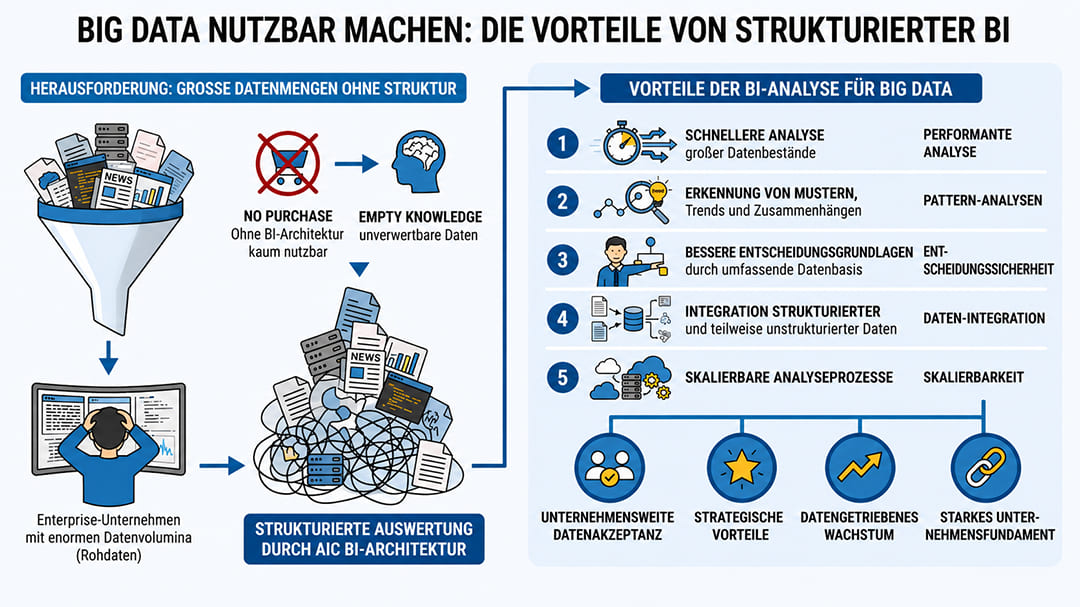
119. IN which industries does AIC Group have BI experience?
Across industries: public authorities and funding institutions, retail, utilities, financial services and building societies, insurance, pharma, entertainment. Many of these customer relationships have existed for more than a decade.
More information on our references: https://www.aicgroup.de/en/references/
If you have further questions about use cases & concrete BI applications, please write to us using our contact form. We look forward to your message!
Introduction, projects & implementation of BI solutions
120. WHAT is the sensible starting point for a BI initiative?
The questions, not the data. Which decisions are coming up, who makes them, which metrics support them? Only from that do the data model, the data supply and the report format follow. Advice before technology.
More information on Data Strategy: https://www.aicgroup.de/en/business-intelligence/#data-strategy
121. HOW does a typical business intelligence project in an enterprise company proceed?
A BI project at AIC Group proceeds in six steps:
• Requirements analysis
• Concept
• Modelling of the analysis objects
• Data integration
• Reports and dashboards
• Further development
Project management frames the whole – from the first assessment through to productive operation.
AIC Group accompanies BI projects end to end – from the first idea to productive use. In doing so, we combine strategic consulting with technical implementation and make sure that solutions are not only implemented but also used in the long term.
Our experience from projects in retail, financial services, utilities and public administration shows: what is decisive for success is a clear target picture and a clean interlocking of business departments and IT.
More information on business intelligence: https://www.aicgroup.de/en/business-intelligence/
122. HOW long does it take to introduce a BI solution?
The duration of a BI project depends heavily on the individual requirements, the existing system landscape and the desired target picture.
Typical time frames include:
• Proof of concept / pilot: a few weeks
• first productive use cases: 2–4 months
• company-wide BI solution: several months up to long-term programmes
AIC Group follows an iterative approach in which first added value is created quickly while a scalable overall architecture is built in parallel.
Typical challenges include:
• complex data landscapes
• need for coordination between business departments
• ensuring data quality
• integration of existing systems
Thanks to our structured approach and our many years of experience in BI consulting, we can plan and implement projects efficiently – without losing sight of the long-term perspective.
More information on BI projects: https://www.aicgroup.de/en/business-intelligence/
123. WHICH prerequisites should be met for a successful BI project?
A successful BI project requires not only the right technology but, above all, clear framework conditions at the organisational and business level.
Important prerequisites include:
• clear definition of goals and concrete use cases
• support from management and business departments
• defined KPI systems and metric logic
• availability of relevant data sources
• sufficient data quality
• clear responsibilities for data and processes
AIC Group supports companies from the early phase onwards in creating these prerequisites and laying a reliable foundation for the project.
Typical stumbling blocks include:
• unclear requirements
• lack of coordination between IT and business departments
• too strong a focus on tools without a strategy
• missing governance structures
With our experience from more than 25 years of BI consulting, we help to avoid these risks early on and set projects up with a clear purpose.
More information on BI strategy: https://www.aicgroup.de/en/business-intelligence/
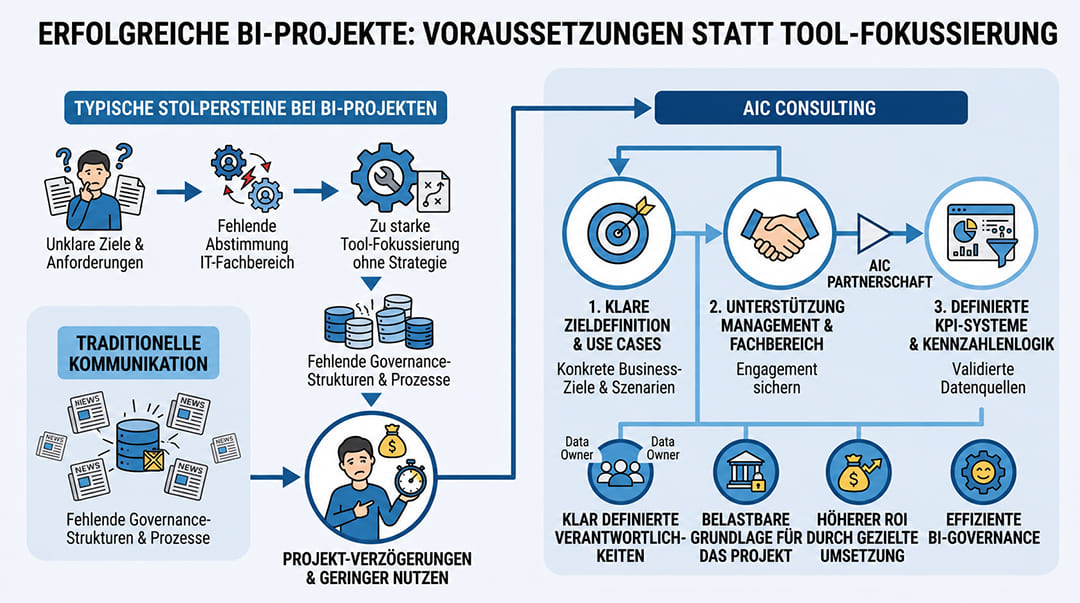
124. WHY do BI projects fail most often?
Rarely because of the technology. More often because the same metric is understood differently, the data quality does not hold up, or nobody is responsible for what a report is supposed to say. We clarify these points early.
More information on business intelligence: https://www.aicgroup.de/en/business-intelligence/
125. HOW does AIC Group support the introduction of Strategy?
AIC Group accompanies companies end to end in introducing and further developing Strategy (formerly MicroStrategy) – from architecture and implementation through to operation.
Our services include:
• Architecture and platform design for Strategy
• Building data warehouses and data models
• Development of reports, dashboards and applications
• Implementation of security and governance concepts
• Performance optimisation and scaling
• Training and enablement of users
As experienced Strategy experts, we know the requirements of complex enterprise environments and develop solutions that are both technically powerful and a precise fit for the business.
Our customers benefit from our many years of project experience and our work with large companies from various industries.
More information on Strategy: https://www.aicgroup.de/en/strategy/
126. HOW does AIC Group support the introduction of Power BI?
AIC Group supports companies in introducing Power BI in a way that is structured, scalable and usable across the company.
Our services include:
• Development of a Power BI strategy and governance
• Building central data models and data sources
• Creation of interactive dashboards and reports
• Integration into existing system landscapes (e.g. Microsoft Azure)
• Establishing self-service BI structures
• Training of business departments and users
Typical challenges include:
• uncontrolled spread of reports
• no central data base
• inconsistent KPI definitions
• performance problems with large volumes of data
AIC Group makes sure that Power BI is not used in isolation but is integrated into a BI architecture as a whole – as a complement to or a component of an enterprise BI strategy.
More information on Data Analytics: https://www.aicgroup.de/en/business-intelligence/#data-analytics
127. HOW do you make sure that BI projects are successful in the long term?
The long-term success of BI projects depends on whether they are integrated into the organisation for the long term and continuously developed further.
Important success factors include:
• clear governance structures
• continuous maintenance and further development of the data models
• regular coordination between business departments and IT
• training and enablement of users
• monitoring of usage and performance
• extension with new use cases and data sources
AIC Group sees BI not as a one-off project but as a continuous development process.
Our customers benefit from the fact that we accompany them in the long term – from the initial implementation to the further development of the BI landscape.
This is crucial in enterprise companies in particular, as requirements, data sources and business models change continuously.
More information on business intelligence: https://www.aicgroup.de/en/business-intelligence/
128. WHICH role does change management play in the introduction of BI solutions?
Change management is a decisive success factor in the introduction of BI solutions – especially in large organisations.
Introducing business intelligence often means a change in ways of working, decision-making processes and responsibilities.
Typical aspects include:
• acceptance of new tools and processes
• switch from manual to automated reports
• introduction of uniform KPI definitions
• more data-based decision-making
• training and support of users
AIC Group treats change management as an integral part of every BI project.
We support companies in involving business departments early, developing training concepts and securing lasting acceptance of new solutions.
Our experience shows: technically successful projects only deliver their full benefit once they are also anchored in the organisation.
More information on business intelligence: https://www.aicgroup.de/en/business-intelligence/
129. HOW can a proof of concept (PoC) in the BI environment look?
A proof of concept (PoC) serves to check the feasibility and the added value of a BI solution quickly and pragmatically, based on concrete use cases.
Typical contents of a PoC include, for example:
• Selection of a clearly delimited use case
• Integration of selected data sources
• Set-up of a first data model
• Development of a dashboard or report
• Validation of data quality and performance
• Coordination with specialist departments
AIC Group uses PoCs deliberately to deliver tangible results quickly and to create a well-founded basis for deciding on the further implementation.
In enterprise projects in particular, this is an effective approach to reduce risks and increase acceptance within the company.
More information on data analytics: https://www.aicgroup.de/en/business-intelligence/#data-analytics
If you have further questions about introduction, projects & implementation of BI solutions, please write to us using our contact form. We look forward to your message!

Operation, scaling & further development of BI solutions
130. HOW is a BI solution operated and developed further after its introduction?
After the successful introduction of a BI solution, the decisive phase begins: sustainable operation and continuous further development.
In enterprise companies, BI is not a static system but a dynamic platform that has to be adapted to new requirements on an ongoing basis.
Typical tasks in ongoing operation include, for example:
• Monitoring of data loading processes and system performance
• Maintenance and extension of data models
• Integration of new data sources
• Adaptation of dashboards and reports
• Ensuring data quality and consistency
• Support for specialist departments and users
AIC Group also supports companies beyond the implementation and helps to set up stable operating and support structures.
Our experience shows: the long-term success of a BI solution depends largely on how well operation, governance and further development are organised.
More information on BI strategy: https://www.aicgroup.de/en/business-intelligence/
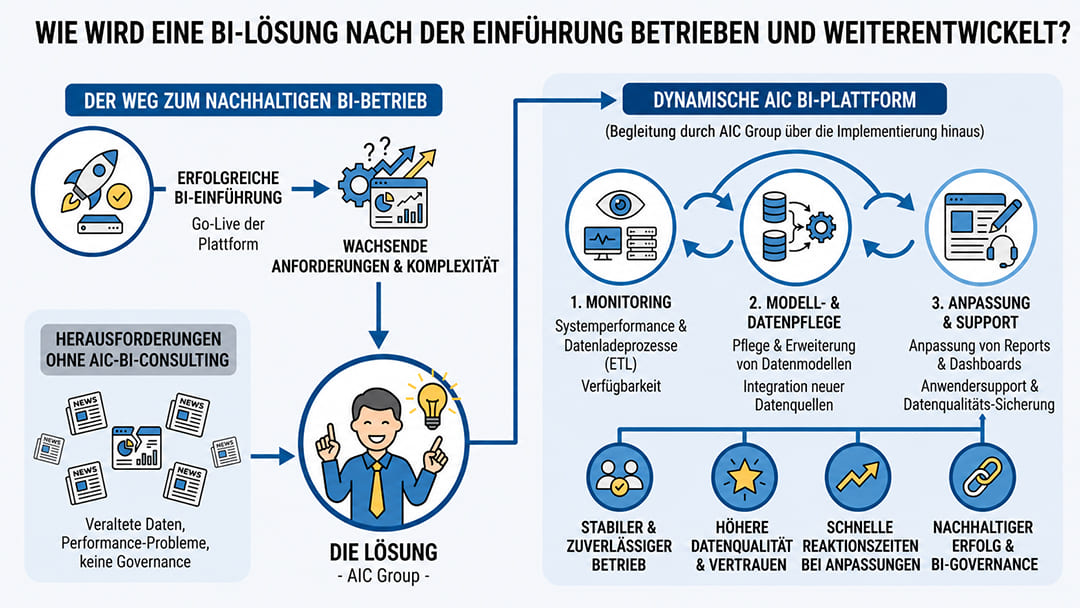
131. WHICH role do managed services play in the BI environment?
Managed services are becoming increasingly important in the BI environment – especially for companies that want to operate their BI landscape efficiently and, at the same time, develop it further flexibly.
Here, an external partner takes on defined tasks in the operation and support of the BI systems.
Typical services include, for example:
• Operation and monitoring of BI systems
• Maintenance and further development of data models
• Support for users and specialist departments
• Performance optimisation
• Ensuring data quality and stability
AIC Group offers flexible support models – from selective consulting through to long-term partnerships in the operation and further development of BI solutions.
In enterprise companies in particular, this relieves internal resources while keeping quality and reliability high.
More information on business intelligence: https://www.aicgroup.de/en/business-intelligence/
132. HOW is data quality ensured in ongoing operation?
Data quality is not a one-off project topic but a continuous task in ongoing BI operation.
Structured processes are required to ensure reliable data in the long term.
Typical measures include, for example:
• automated validation and checking mechanisms
• monitoring of data loading processes
• clear definition of data responsibilities
• regular quality checks
• documentation of data origins (data lineage)
AIC Group supports companies in setting up sustainable data quality and governance structures.
Our experience shows: only if data quality is ensured in the long term can BI solutions serve as a reliable basis for decisions.
More information on data integration: https://www.aicgroup.de/en/business-intelligence/#data-integration
133. HOW can new requirements and use cases be integrated into existing BI systems?
In enterprise companies, new requirements for BI systems arise continuously – whether through new business models, additional data sources or changed management needs.
A flexible BI architecture makes it possible to integrate these requirements efficiently.
Typical extensions include, for example:
• Integration of new data sources (e.g. new systems or external data)
• Extension of data models and KPI systems
• Development of new dashboards and reports
• Integration of additional specialist departments
• Extension to include new analysis and forecasting use cases
AIC Group deliberately develops BI solutions to be modular and extensible, so that new requirements can be implemented without fundamental breaks in the system.
In doing so, we make sure that existing structures remain stable and that innovation is made possible at the same time.
More information on data architecture: https://www.aicgroup.de/en/business-intelligence/#data-integration
134. WHICH role do partnerships and certifications play in the BI environment?
Partnerships and certifications are an important indicator of quality in the BI environment – especially for enterprise companies that depend on stable, scalable and future-proof solutions.
They show that a consulting partner has well-founded know-how, project experience and access to best practices for the respective technology.
AIC Group has been working with Strategy (formerly MicroStrategy) for more than 25 years and has been a Premium Partner since the beginning of 2026. We are also a partner of STACKIT, the European hyperscaler from the Schwarz Group.
In addition, our consultants – particularly in the Microsoft environment – hold relevant certifications and have extensive project experience, which ensures a professional and secure implementation.
For our customers, this means:
• access to proven methods and best practices
• high quality in architecture, implementation and operation
• reduced project risks
• long-term security in technology decisions
At the same time, our approach always remains solution-oriented and not tool-driven: the focus is always on the best solution for the respective company requirement.
More information on Strategy: https://www.aicgroup.de/en/strategy/
If you have further questions about operation, scaling & further development of BI solutions, please write to us using our contact form. We look forward to your message!
Trends, future & innovation in BI
135. WHICH current trends are shaping the business intelligence environment?
The business intelligence environment is developing continuously and is increasingly shaped by new technologies, growing data volumes and changed requirements for companies.
The most important trends include, for example:
• Artificial intelligence and advanced analytics for forecasts and automated decisions
• Self-service BI for stronger involvement of specialist departments
• Cloud-based BI architectures for more flexibility and scalability
• Real-time analyses for faster reactions to market changes
• Data democratisation – broad access to data within the company
• Integration of BI into operational processes
AIC Group supports companies in using these trends in a targeted way and integrating them into existing BI strategies.
Our experience shows: the added value does not come from individual technologies but from combining them sensibly in a clear overall strategy.
More information on business intelligence: https://www.aicgroup.de/en/business-intelligence/
136. WHICH role does artificial intelligence (AI) play in the BI environment?
Artificial intelligence extends classic business intelligence approaches with the ability not only to evaluate data but also to predict future developments and derive automated recommendations for action.
Typical areas of use include, for example:
• Forecasting of revenue, sales and demand developments
• Detection of patterns and anomalies in large data volumes
• automated segmentation of customers and markets
• Derivation of next best actions
• Support of decision-making processes through data-based recommendations
AIC Group combines classic BI with modern analysis approaches and integrates AI where it offers real added value.
Especially in combination with data-driven customer engagement, new possibilities arise not only to analyse decisions but to steer them actively.
More information on data analytics: https://www.aicgroup.de/en/business-intelligence/#data-analytics
137. HOW is self-service BI developing in the enterprise environment?
Self-service BI is becoming increasingly important in the enterprise environment, as specialist departments want to carry out analyses independently and access data more quickly.
However, this approach also brings challenges with it.
Typical advantages include, for example:
• faster analyses by specialist departments
• less dependence on IT departments
• greater flexibility for individual evaluations
Typical challenges include, for example:
• inconsistent KPI definitions
• uncontrolled spread of reports
• no central data base
• increasing effort for governance and quality assurance
AIC Group supports companies in reconciling self-service BI and central control.
A proven approach is the combination of:
• a central data base and clear KPI definitions
• governance structures
• flexible analysis tools such as Power BI
The result is a BI landscape that offers both control and flexibility.
More information on data analytics: https://www.aicgroup.de/en/business-intelligence/#data-analytics
138. HOW is the role of BI changing in data-driven companies?
In data-driven companies, business intelligence is developing from a pure reporting tool into a central management instrument for the entire company.
BI is increasingly becoming:
• an integral part of decision-making processes
• the basis for strategic and operational management
• a driver of innovation and new business models
• the link between data, processes and measures
AIC Group supports companies on the way to becoming a data-driven company by linking BI, data strategy and operational systems with one another.
This is not only about analyses but about actively integrating data into business processes – for example in sales, marketing or customer management.
More information on business intelligence: https://www.aicgroup.de/en/business-intelligence/
139. WHAT significance do real-time data and real-time analytics have?
Real-time data is becoming increasingly important in the BI environment, as companies have to react more quickly to changes.
Real-time analytics makes it possible to capture and evaluate data almost in real time and to turn it into decisions.
Typical use cases include, for example:
• Monitoring of business metrics in real time
• Steering of online and e-commerce activities
• Reaction to market changes and demand developments
• Monitoring of processes and systems
AIC Group supports companies in integrating real-time data sensibly into their BI architecture.
What matters here is that not all data has to be processed in real time – but specifically the data for which speed creates real added value.
More information on data integration: https://www.aicgroup.de/en/business-intelligence/#data-integration
140. HOW can business intelligence be connected with customer engagement and marketing automation?
Connecting business intelligence with customer engagement and marketing automation opens up new possibilities for transferring data-based insights directly into operational measures.
While BI primarily analyses what has happened and why, marketing automation enables the active steering of customer interactions.
Typical usage scenarios include, for example:
• Use of BI analyses for target group segmentation
• Derivation of personalised campaigns from data analyses
• Integration of customer behaviour into automated processes
• Measurement and optimisation of campaign performance
AIC Group connects these worlds through an end-to-end approach:
Business intelligence provides the basis for decisions, while the Marketing Automation Studio (MAS) enables the operational implementation.
This creates a closed loop of:
Data → analysis → decision → action → new data
For enterprise companies in particular, this integration offers enormous potential to shape customer relationships in a data-driven and scalable way
More information on data analytics: https://www.aicgroup.de/en/business-intelligence/#data-analytics

141. WHICH future prospects does business intelligence have in the coming years?
In the coming years, business intelligence will continue to develop towards automated, intelligent and integrated systems.
Important developments include, for example:
• stronger integration of AI and machine learning
• increasing automation of analyses and decisions
• closer interlinking with operational systems
• even greater use of cloud technologies
• growing importance of data as a strategic success factor
AIC Group supports companies in making their BI landscapes future-proof and integrating new technologies sensibly.
Our experience shows: successful companies invest not only in tools but in a data strategy as a whole.
More information on business intelligence: https://www.aicgroup.de/en/business-intelligence/
If you have further questions about trends, the future & innovation in BI, please write to us using our contact form. We look forward to your message!
Security, data protection & compliance in BI
142. WHICH role do data protection and compliance play in the business intelligence environment?
Data protection and compliance are central requirements in the business intelligence environment – especially for enterprise companies that process large volumes of sensitive data.
BI systems frequently access personal, financial or business-critical data. All processes and technologies must therefore comply with the applicable legal and regulatory requirements, in particular the GDPR.
Typical requirements include, for example:
• Protection of personal data
• Compliance with legal requirements (e.g. GDPR)
• transparent data processing and use
• clear rules for access and permissions
• Documentation of data flows and origins
AIC Group supports companies in designing and implementing BI solutions in such a way that data protection and compliance are taken into account from the start.
In regulated industries in particular, our experience shows: trust in data is the basis for successful data-based decisions.
More information on business intelligence: https://www.aicgroup.de/en/business-intelligence/
143. HOW is it ensured that sensitive data in the BI system is protected?
The protection of sensitive data is a central part of every BI architecture and comprises both technical and organisational measures.
Typical security measures include, for example:
• role-based access concepts (role-based access control)
• Encryption of data (in transit and at rest)
• Separation of data by sensitivity and user groups
• Logging of access and changes
• Use of secure authentication methods
AIC Group develops security concepts that are matched exactly to the requirements of enterprise companies.
In doing so, we take both technical aspects and organisational processes into account in order to ensure end-to-end protection of sensitive data.
More information on data integration: https://www.aicgroup.de/en/business-intelligence/#data-integration
144. HOW can BI solutions be implemented in a GDPR-compliant way?
The GDPR-compliant implementation of BI solutions requires a combination of technical measures, clear processes and organisational rules.
Important aspects include, for example:
• Data minimisation and purpose limitation in the use of data
• Pseudonymisation or anonymisation of personal data
• clear consent and deletion concepts
• transparent documentation of data processing
• Implementation of data subject rights (e.g. access, erasure)
AIC Group takes data protection requirements into account as early as the design of BI architectures (“privacy by design”).
In doing so, we work closely with the people responsible for data protection and compliance in the respective company.
Important: we do not provide legal advice, but we do support the technical and organisational implementation of BI solutions that comply with data protection requirements.
More information on data architecture: https://www.aicgroup.de/en/business-intelligence/#data-integration
145. WHICH challenges are there with security and compliance in BI projects?
Security and compliance often pose complex challenges in BI projects – especially in large IT landscapes that have grown over time.
Typical challenges include, for example:
• Integration of sensitive data from different systems
• different security requirements for each specialist department
• lack of transparency about data flows
• complex permission concepts
• Coordination between IT, specialist departments and compliance
AIC Group brings extensive experience from enterprise projects to this and supports companies in developing solutions that are pragmatic and secure at the same time.
In doing so, we make sure that security requirements do not come at the expense of usability and performance.
More information on business intelligence: https://www.aicgroup.de/en/business-intelligence/
146. HOW can you create transparency and trust in BI data?
Trust in data is one of the most important prerequisites for successful business intelligence initiatives.
Only if users trust the data will they actively include it in their decisions.
Important measures include, for example:
• clear definition and documentation of KPIs
• transparent data origin (data lineage)
• uniform data models and metric logic
• high data quality and validation processes
• traceable calculations and reports
AIC Group attaches great importance to designing BI solutions so that they are transparent, traceable and trustworthy.
Our experience shows:
Trust does not come from technology alone but from clear structures, consistent data and traceable processes.
More information on data analytics: https://www.aicgroup.de/en/business-intelligence/#data-analytics
147. WHICH role does IT security play in cloud-based BI solutions?
Cloud-based BI solutions offer many advantages but also place particular demands on IT security.
Important aspects include, for example:
• secure data transmission and storage
• access controls and identity management
• compliance with regulatory requirements
• selection of suitable cloud providers
• securing of interfaces and integrations
AIC Group supports companies in the secure implementation of cloud BI architectures – both in pure cloud and in hybrid scenarios.
In doing so, we make sure that security requirements are implemented consistently without restricting the flexibility and scalability of the cloud.
More information on data integration: https://www.aicgroup.de/en/business-intelligence/#data-integration
148. HOW can BI be operated in compliance with data protection and in Europe?
Via European cloud environments. We are a partner of STACKIT, the European hyperscaler from the Schwarz Group. This allows BI environments to be operated where the data does not leave Europe. Operation in your own data centre remains possible as well.
More information on STACKIT: https://www.aicgroup.de/en/stackit/
If you have further questions about security, data protection & compliance in BI, please write to us using our contact form. We look forward to your message!


