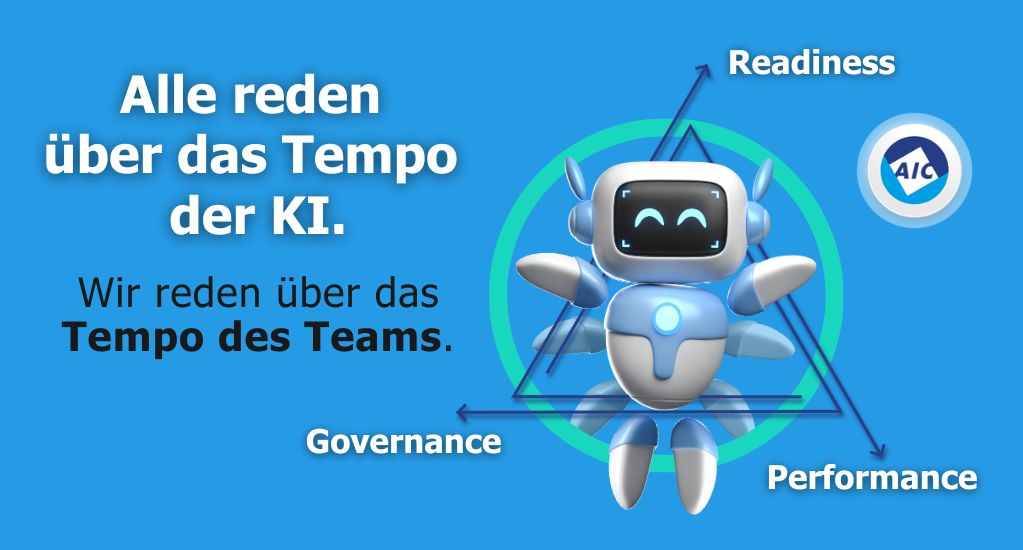
Everyone is talking about the speed of AI. We talk about the speed of the team.
There is one sentence we like to say about our AI agent: it is not a copywriter but a sparring partner.
The first three parts of this series were about making it one. How we got started internally at AIC Group GmbH. Why the knowledge base matters more than the perfect prompt. And most recently, that an agent does not get better through use but through care.
Along the way, we silently assumed one thing: that the team can keep up with the agent at all. Today we talk about exactly that. Because the best agent comes to nothing if the organisation around it cannot carry it.
Sparring needs a counterpart
Sparring is not a solo exercise. It takes two sides: one that challenges, and one that keeps up, puts things into context and gives something back. A sparring partner that meets nobody who can match its level is not sparring. It is just producing for nobody.
Our own claim stands or falls with this. “AI as a sparring partner” is not a promise about the machine but a demand on us. Whether it turns into real sparring is not decided by the agent. It is decided by how ready the organisation is to work with it.
The blind spot: a good agent shifts the problem
Approach, knowlege, care – for three parts, the focus was on making the agent good. That is half the truth. The other half: a good agent does not solve the actual problem. It shifts it.
The more reliable the agent becomes, the more depends on the team that carries it. As long as the results are mediocre, the agent is the bottleneck. As soon as they are good, the team is the bottleneck. It is exactly this transition that gets underestimated in practice.
An AI is only as fast as the team that can carry it.
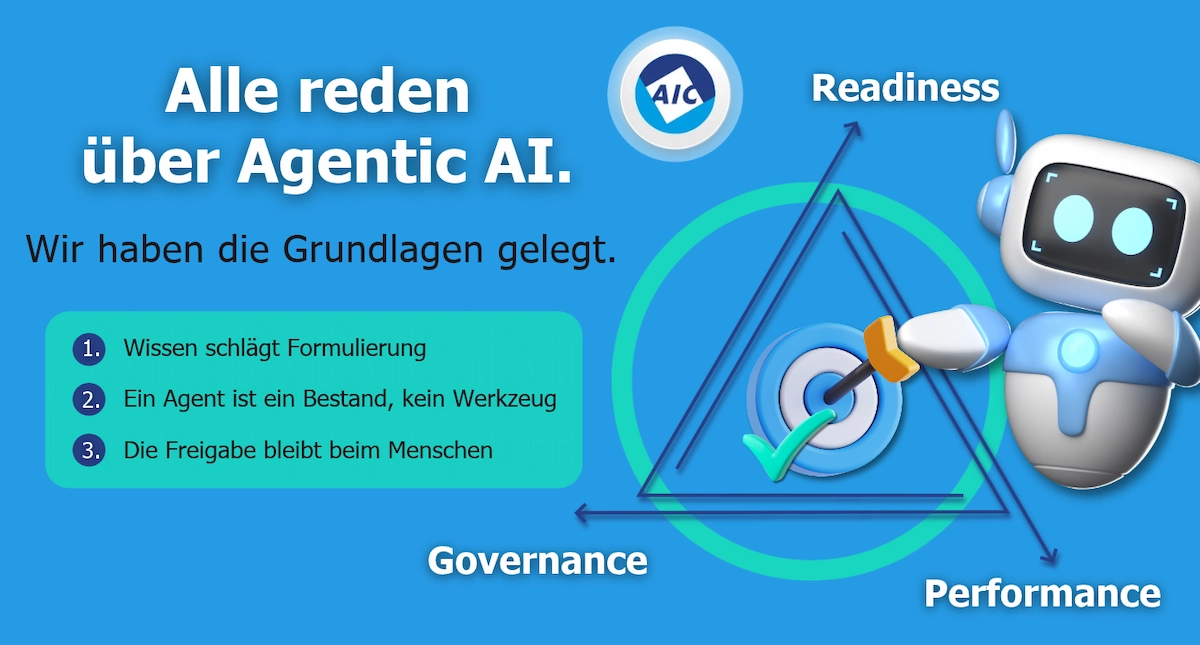
Three prerequisites: readiness, governance, performance
For an agent to have a lasting effect, three organisational prerequisites are needed, in this order.
Readiness is the maturity of the team. Does the team have the knowledge, the willingness and the subject-matter grounding to work with the agent? Without readiness, every agent remains a black box.
Governance means the guard rails. Who uses which agent for what, how are results checked, where does responsibility lie? Governance prevents speed from coming at the expense of quality.
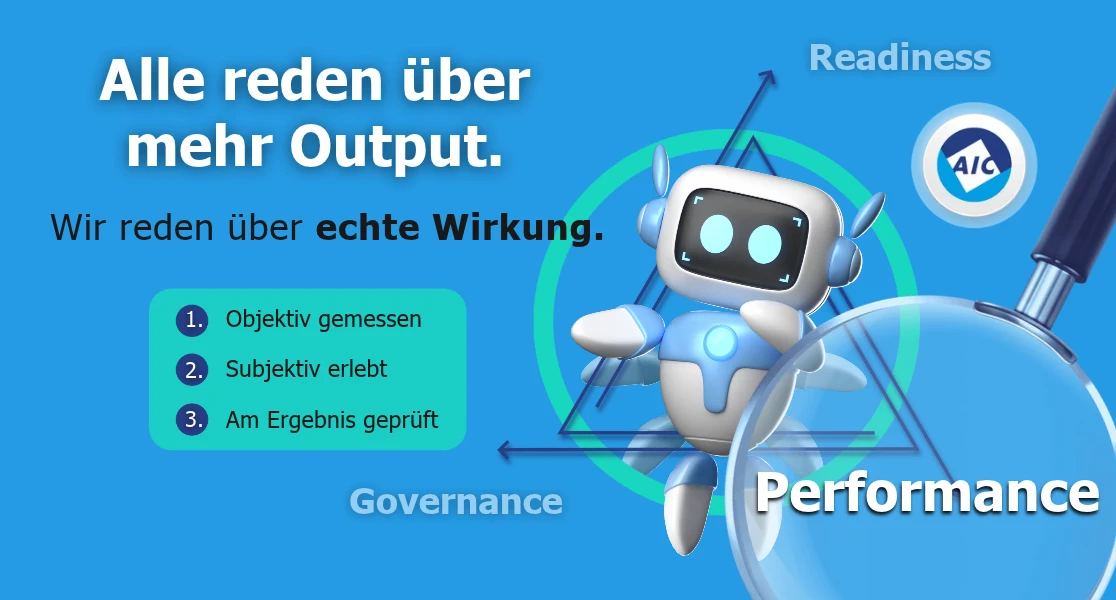
Performance is the effect on day-to-day business: not the speed of the machine, but what actually ends up better, faster and more consistent.
The order is no accident. Demanding performance without readiness builds pressure that overloads the team. Setting governance without readiness establishes empty rules. Each pillar deserves a closer look of its own, and we will come back to them in the next parts. Today is about the point where all three meet: speed.
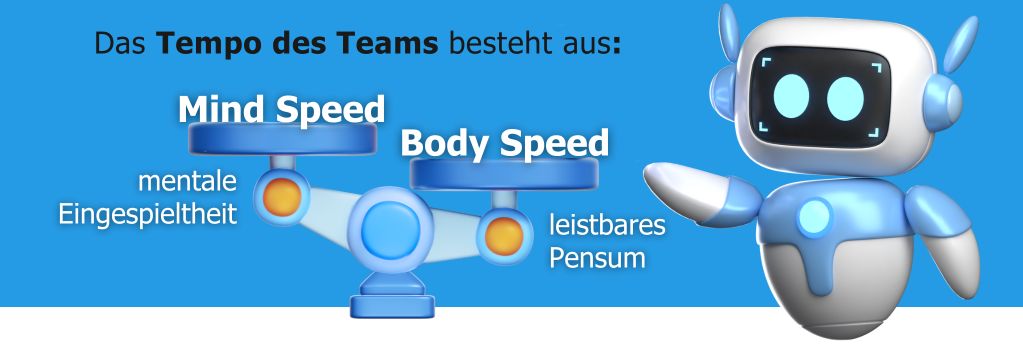
Mind Speed and Body Speed
AI agents make possible a speed that a team cannot reach on its own. That is the temptation. And the trap.
Behind it are two speeds:
Mind Speed is mental attunement: how firmly people’s minds are tuned to the guard rails, the knowledge and the quality standards. Anyone who has internalised the system prompt, the knowledge base and the criteria can assess output quickly and take responsibility for it.
Body Speed is the workload people can actually manage. Even a well-attuned team cannot make, check and answer for an unlimited number of decisions per hour.
The tension between the two is the decisive point. When the speed of the machine overwhelms the speed of the people, the result is not efficiency but exhaustion. And exhaustion slows down not just the individual but the whole process. The supposed acceleration goes into reverse.
The bottleneck shifts
This can be made concrete, using our own experience.
At the start of working with an agent, the work consists mainly of telling it what is wrong. You correct, refine, reject. Tiring, but manageable.
With every step the output matures, and the work changes. It is less and less about fixing mistakes and more and more about putting increasingly good output into context, taking responsibility for it and thinking it through further. That sounds like relief. In truth it is the more demanding mode. Correcting is reacting. Putting things in context and thinking them through takes effort of your own, especially when several topics run in parallel.
That is the uncomfortable part of the truth about good AI: it does not simply take work off your hands. It shifts human work to where it demands the most. And it is exactly at this point that Body Speed becomes a real limit.
What this means in practice
The consequence is not a brake but a question of steering.
The pace of production follows the workload people can manage, not the theoretical speed of the AI. Escalation and decision points are set deliberately: who decides what, and when? Breaks, reflection and quality loops are planned in, not rationalised away. And growth happens step by step: stability first, then scaling.
That is performance in practice, in the sense of the model: not the fastest team, but the one that can keep up its pace.
What this means for other companies
Organisational maturity decides whether a good agent leads to real sparring, or just faster output that in the end nobody takes responsibility for. Readiness, governance and performance are the framework for this. Mind Speed and Body Speed are where it gets concrete in everyday work.
We are deliberately leaving one observation open here, because it deserves an article of its own. The better the agent gets, the greater the temptation to work mainly with it, and less often with colleagues who take longer to get up to speed and whose feedback is less comfortable. Ourselves included. What that does to collaboration in the team is the really delicate question. More on that soon.
How do you handle it? Do you set the pace of your AI work by what the machine can do, or by the workload your team can really carry? Write to us. We are happy to share our experience.