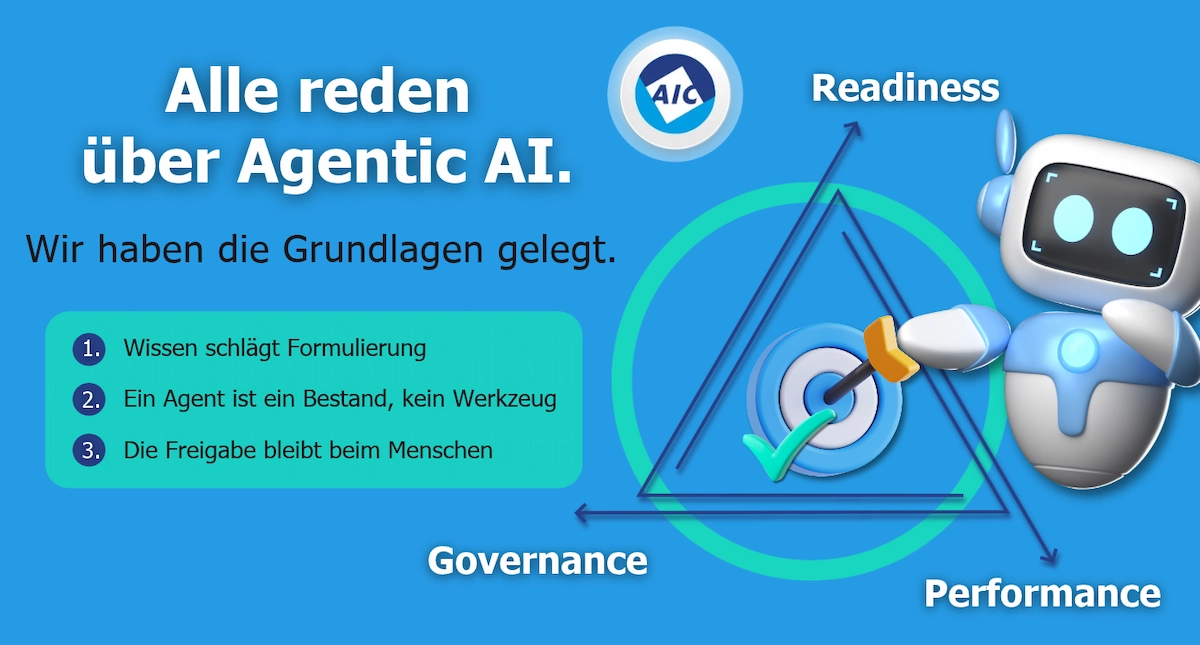
Everyone is talking about getting started with AI. We talk about the maturity before it.
The last two articles in this series were about the organisation behind the agent we use every day at AIC Group: the pace a team can carry, and the collaboration that must not get lost along the way.
Beide Male stand ein Begriff im Hintergrund, ohne dass wir ihn aufgeschlüsselt haben: Readiness. Die erste der drei organisatorischen Voraussetzungen, die wir in dieser Reihe Readiness, Governance und Performance nennen. Zuletzt endete der Faden genau dort. Heute nehmen wir ihn auf.
Both times, one term stayed in the background without us unpacking it: readiness. The first of the three organisational prerequisites that we call readiness, governance and performance in this series. Last time, the thread ended right there. Today we pick it up.
Maturity is not a mood
“Are we ready for AI?” The question sounds like self-assessment, gut feeling, a complicated maturity model. Asked like that, it paralyses. It is too big to allow a clear answer.
Wir stellen sie deshalb anders. Nicht: Ist das ganze Unternehmen reif für KI? Sondern: Ist die Grundlage da, um einen ersten, klar abgegrenzten Agenten verlässlich aufzustellen?
That very step, from the whole to the single agent, makes the difference. One big, vague question becomes three concrete ones you can answer. We call them knowledge readiness, process readiness and oversight readiness.
Knowledge readiness: brought together, not scattered
An agent is only as good as the knowledge it draws on. The question is not whether the company has knowledge; it almost always does. The question is whether it is within reach: structured, current, reliable, brought together in one place instead of spread across folders, email threads and people’s heads.
If you don’t have the knowledge base under control, you get a generic agent instead of a specific one. That matches what we described in the second article: knowledge beats prompt length.
For us, this place grew over time, not as a ready-made source we tap into but as the result of work. We brought knowledge together from existing documents, condensed it, structured it and made it machine-readable, and we have kept developing it ever since. The content differs for everyone; the principle is the same: not one more document, but one place where the knowledge comes together.
The test question: is the knowledge for your agent brought together and structured in one place, or would you have to hunt for it first?
Process readiness: what cannot be described cannot be delegated
An agent can only support what can be put into words. That sounds trivial, but it is the most common blind spot. Many tasks in a team run “by feel”: experienced people do them right without anyone ever having written down how.
As long as a task exists only in someone’s head, an agent cannot support it. Only once it can be described, step by step and with its decision points, can it be delegated. Recurring, described tasks become skills.
For us, this was often the underestimated part: not the tool, but writing down what we had long known how to do but had never recorded. The effort pays off twice: the task not only becomes something you can delegate, it also becomes clearer within the team.
The test question: can you write down, step by step, the task the agent is meant to take on, or does it only live in a few people’s heads?
Oversight readiness: who checks, approves, escalates
The third facet is the easiest to overlook because it sounds like bureaucracy. It isn’t. It is the question of who checks the agent’s output, who approves it and who decides when something gets stopped.
Human oversight is not a brake. It is the prerequisite for entrusting an agent with anything at all. Whoever approves takes responsibility, and that is exactly what makes using the agent viable.
For us it is clearly assigned who checks and approves, and who has the final say on sensitive content. Both roles are filled and known in the team.
The test question: is it settled who is responsible for the output, who signs off and who decides when to stop?
And this is where the next pillar already shows: oversight is the point at which readiness turns into governance. More on that in the next article.
The yardstick: one agent, not the whole organisation
These three questions are about the first agent. Not the whole company.
That matters, because otherwise “AI maturity” immediately sounds like a big transformation project: system landscape, company-wide roles, budgets, the strategic role of IT. All of that becomes relevant once agents spread through the organisation. But it belongs to later stages, not to the foundations of the first agent.
If you wait for full maturity, you never start. If you can answer the three questions for a specific, small use case, you are ready enough to begin. That is exactly what we did.
What this means for other companies
Readiness is not a maturity certificate you pass or fail. It is three questions you can answer honestly for a specific agent, and where an answer is missing, you know what to do first.
Knowledge readiness: knowledge that comes together in one place. Process readiness: a task you can describe. Oversight readiness: responsibility that is settled. If one of the three is missing, the foundation gives way, and even the best agent stands on shaky ground.
Which of the three is your sore spot?
Write to us. We’d be happy to share our approach.