A few months ago, we started building an AI agent internally at AIC Group GmbH. Not as a formal pilot project. Not with an external agency. Not via an IT ticket.
That the topic is everywhere right now was plain to see at OMR in Hamburg, too: keynotes, panel discussions, conversations over coffee. What struck us: many companies know they should get to grips with agentic AI. But getting started often feels like a big step. Like an IT project. Like budget. Like an external solution. Like time nobody has right now.
We know this pattern well. And by now we know from our own experience: there is another way.
The use case: content creation. Specifically, planning and writing our LinkedIn and Instagram posts.
Why this use case? Because the threshold is low. Marketing content is publicly available; it contains no confidential information and no sensitive data. You don’t need an elaborate data project to start. What you need is a clear approach.
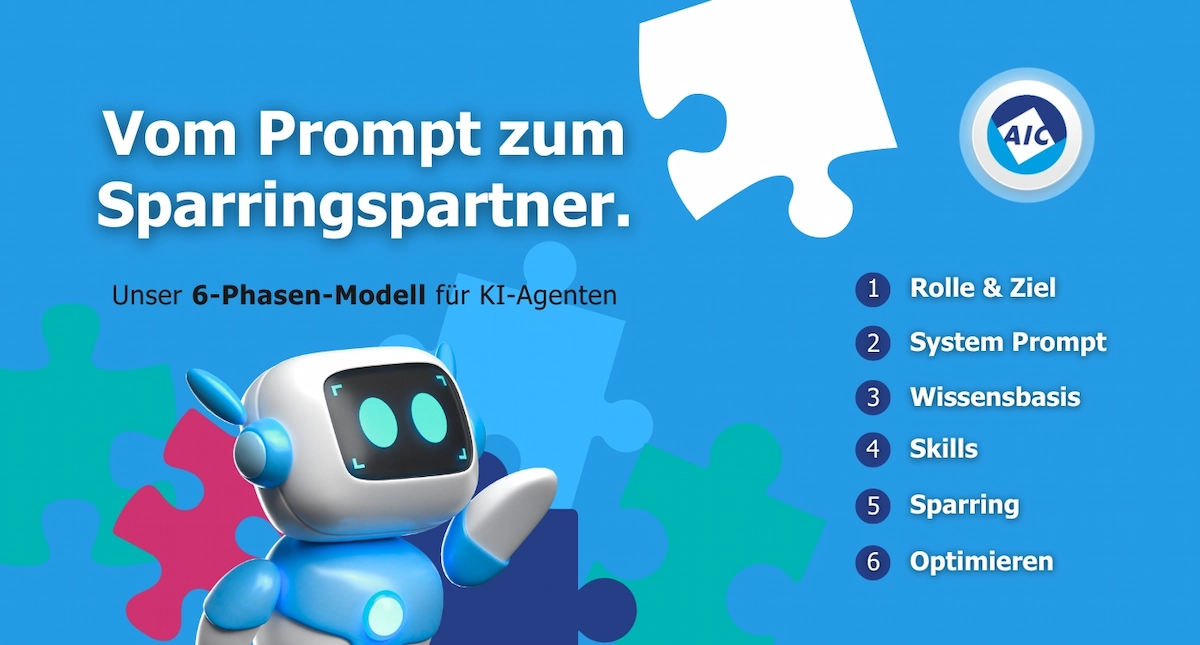
A working agent is no accident. It comes about through decisions, and through iteration. Our process follows six phases.
Phase 1 – Define role & purpose
What is the agent to be used for? What are its tasks, and which are explicitly not? Without this clarity the agent stays generic.
Phase 2 – Develop the system prompt
The system prompt is the heart of it. It defines context, role, tone, way of working and quality standards. It does not make the agent creative; it makes it reliable.
Phase 3 – Build the knowledge base
An agent is only as good as the knowledge available to it. For this we created structured documents: positioning basics, language rules, design guidelines, editorial plans.
Three types of source have proven themselves: strategic and subject-matter documents, style and format guidelines, and planning documents.
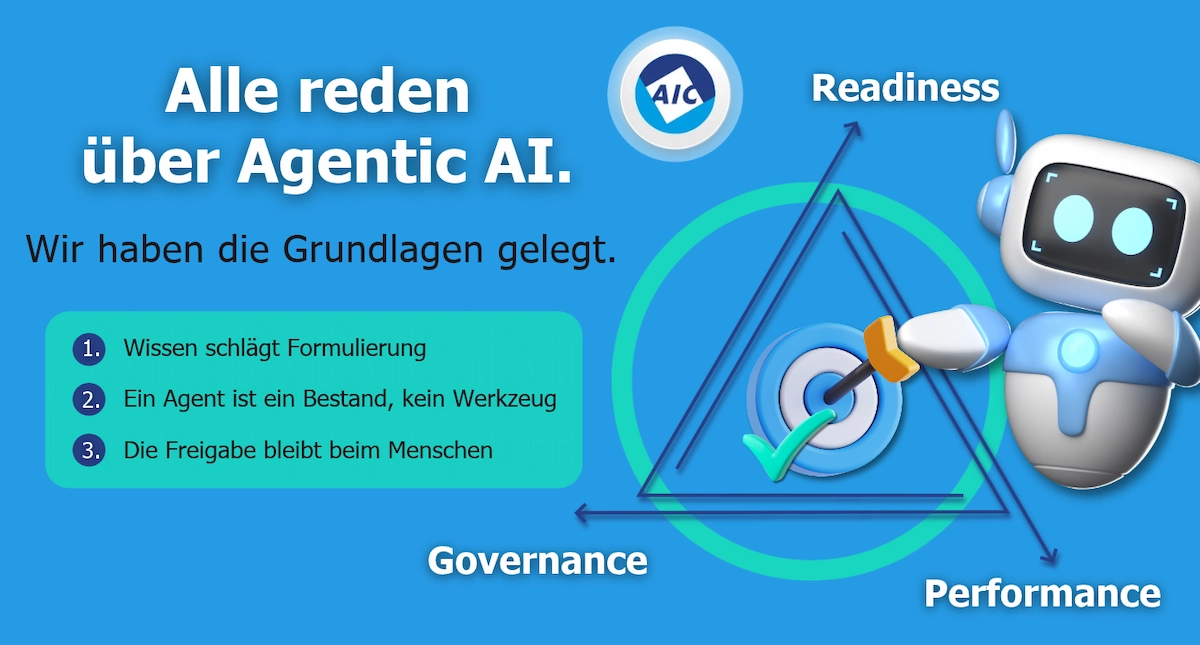
Knowledge beats prompt length.
Phase 4 – Develop skills
For recurring tasks we developed predefined working instructions, known as skills. They make sure the agent delivers consistent, reproducible results without having to be instructed from scratch every time.
The knowledge base supplies the what and the why, the skill the how.
Phase 5 – Work with the agent
An agent is not a copywriter. It is a sparring partner.
Dialogue instead of perfect prompts. Feedback instead of starting over. .
Working like this gets you to better results faster.
Phase 6 – Improve continuously
Every wrong output is a chance to learn. The improvement loop (spot the error, find the cause, refine) is crucial for long-term quality.
Every wrong output makes the agent better.
We worked with ChatGPT and Claude, two models that hardly need explaining any more. What became clear: no model beats another across the board. It depends on the context. AIC Group GmbH takes a tool-agnostic approach to consulting: what matters is the approach, not the tool.
What really makes the difference is not the model. It is the quality of the knowledge base and the clarity of the system prompt.
And: an agent is not created once. It develops through use.
In conversations with other companies, and when AI vendors visit us to present their solutions, we see the same pattern again and again.
Many vendors build interfaces that make accessible exactly what defines an agent: system prompt, knowledge base, predefined working instructions. Behind them sits a language model, supplemented by integrations into the website, the CMS, existing workflows.
That is not a bad approach. But it does not solve one challenge: building the groundwork properly.
What should the agent know? How should it communicate? Which tasks should it handle reproducibly? This work always remains. Whether with your own agent or with a service provider.
That is exactly what confirmed our decision: we build the groundwork ourselves. Not because we reject tools, but because we want to understand what makes a good agent. And because this knowledge is reusable. For the next use case. And the one after that.
Content creation is one way in. The process model is transferable.
What became visible at OMR, and what we have been experiencing in conversations for months: the will to engage with agentic AI is there. What is missing is a concrete, feasible way in. No tool sales. No promises that are too big.
If you are thinking about where your first use case could be: feel free to write to us on LinkedIn. We are happy to share our approach.*