Why we rebuilt our Marketing Automation Studio (MAS)
The right message, at the right time, through the right channel. Every marketing manager has heard this sentence a hundred times; it is in every tool brochure in our industry.
What is said less often is where it fails in practice. Because the promise is not the problem. Customers’ decisions really are more individual than ever: when they buy, what interests them, where they can be reached. The problem is that “right” requires the same thing three times over: a complete picture of every single customer. If you only know your customers in fragments, you personalise fragments.
That is exactly the point we tackled, by rebuilding our Marketing Automation Studio (MAS) from the ground up. Before our team shows the individual building blocks in detail, I would like to explain why. It was not a technical decision. It was a strategic one.
One central data base, for four reasons
That is why the core of the new MAS is a central data base on which everything else builds. That sounds unspectacular. Strategically, it is the most important decision in the entire product.
First: independence.
If you spread your customer data across many external tools, you make yourself dependent: on interfaces, licensing models and other vendors’ decisions. Your own central data storage gives you back control.
Second: consistency.
When segmentation, campaign logic and analysis work on the same data set, the numbers stop contradicting each other. Decisions become reliable because everyone is talking about the same customer behaviour.
Third: personalisation.
Personalised communication only happens when profile, behaviour and context are looked at together. Scattered data lets you reach customers. Consolidated data lets you be relevant to them.
Fourth: AI.
Predictive models are only as good as the data they learn from. Anyone who wants to use AI in marketing seriously and for the long term needs a consistent, well-maintained data base. No model in the world can make up for scattered or contradictory data.
Three building blocks as a consequence
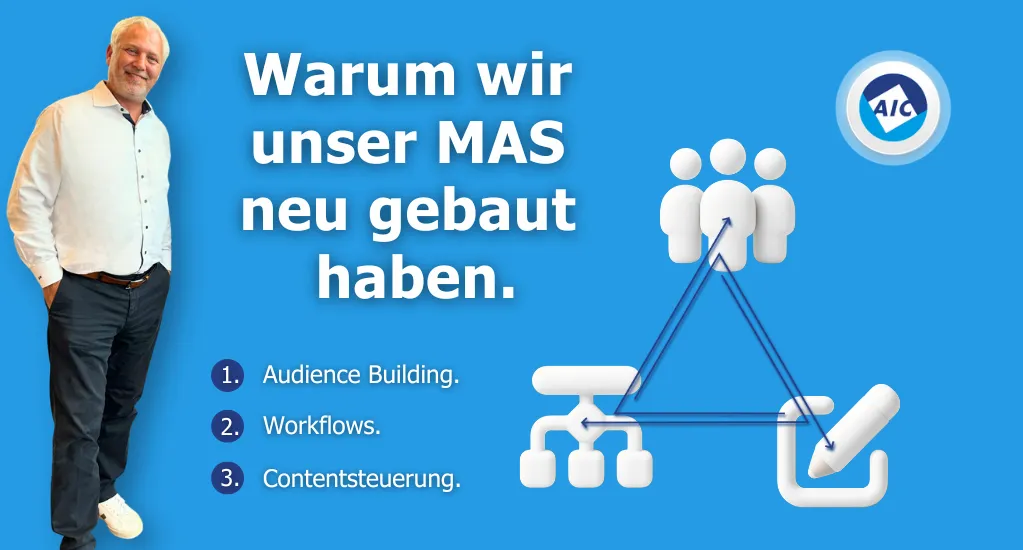
Three building blocks follow from this foundation, and our team is presenting them over the coming weeks: audience building that forms target groups from master data, behaviour and references. Workflows that tailor journeys to each individual customer, at the right moment, through the right channel. And content control that delivers content and offers dynamically. None of these building blocks would be what it is without the central data base. That is the difference between features and architecture.
What the MAS deliberately is not
Just as important as what we built is what we deliberately did not build. The MAS replaces neither your customer database nor your creativity. It is the software in between: the central marketing view of your data, between your data sources and your channels.
This clarity is part of our stance. We don’t believe in platforms that promise to do everything. We believe in a solution that solves one thing rigorously: turning customer data into relevant, automated and measurable communication.
Who we built it for
Our focus is on mid-sized companies, retail and the agencies that work for them. Organisations that want to respond to changing customer behaviour without taking on an enterprise project. That is exactly what the MAS is designed for: modular to start with, scalable as you grow.
Our team will soon give a first look at the new MAS on LinkedIn. The three building blocks will then follow in detail.*
If you have questions before then or would like to get to know the MAS in conversation, feel free to write to me at meetme@aicgroup.de.