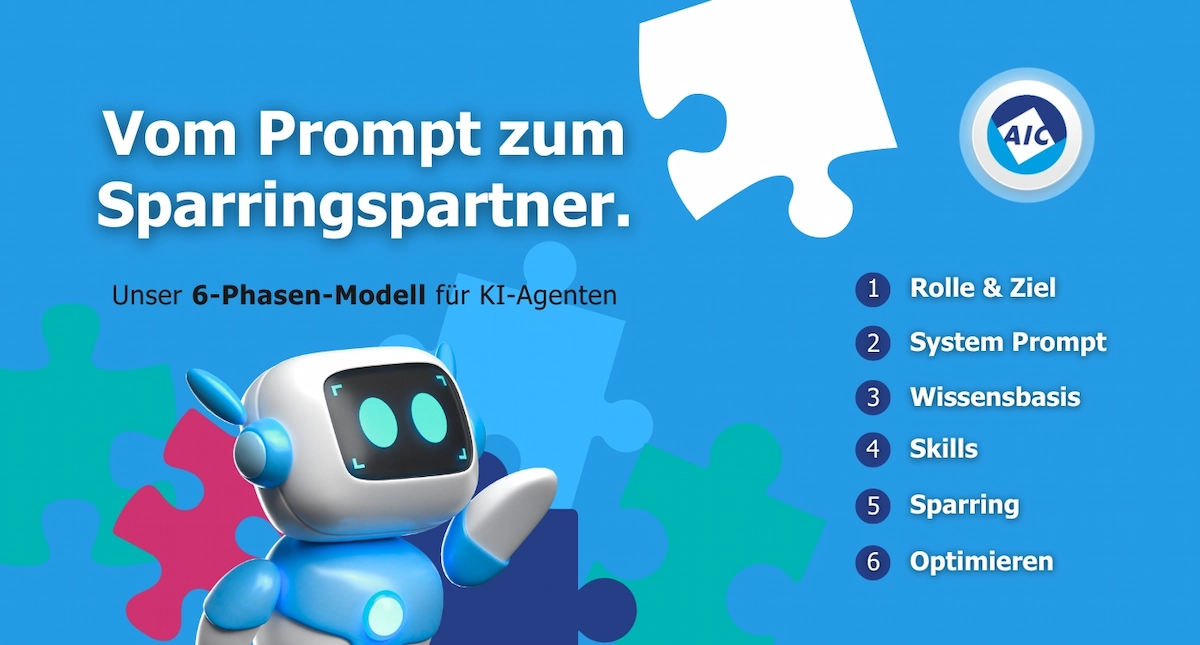
In the first two articles of this series, we described how we built an AI agent internally at AIC Group GmbH with a clear use case, a six-phase-model and a knowledge base as the foundation One insight ran through both parts: an agent is not created once. It develops through use.
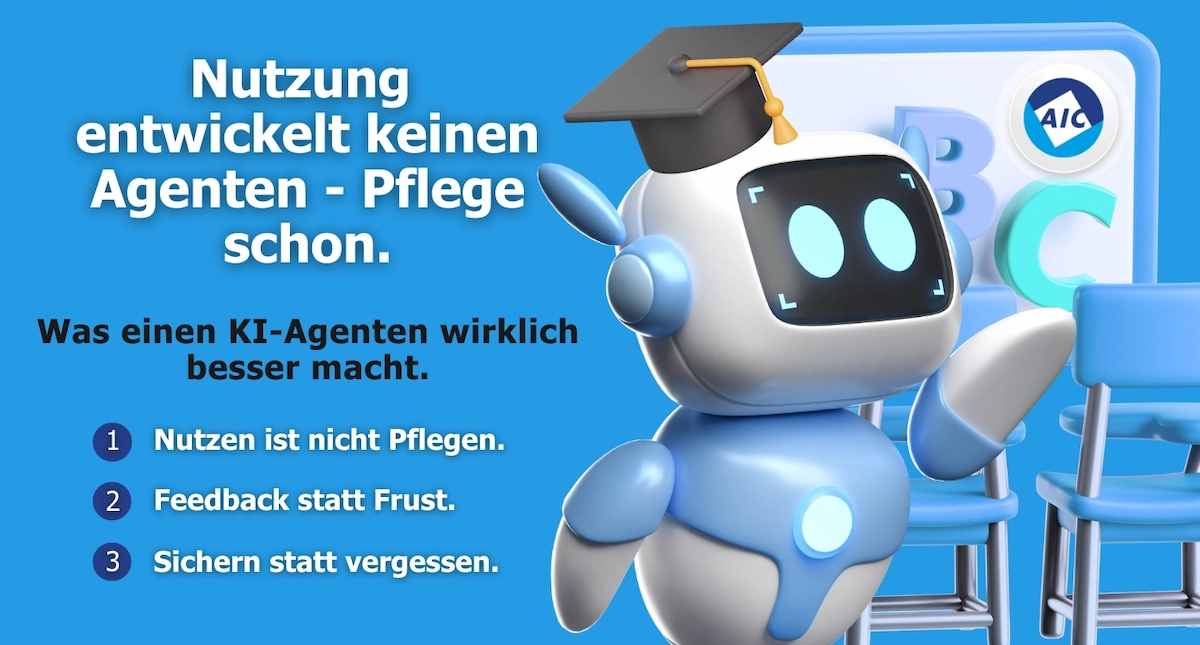
Today we want to sharpen that sentence, because it is only half the truth: use does not develop an agent. Care does.
We see the same pattern again and again: someone tries out an AI assistant, is disappointed with the result, and concludes that the tool is no good.
The obvious explanation is usually: a bad prompt. Too vague, too little context, too thin on detail. That is often true. But it is not the core.
Because there is a misunderstanding going around about working with AI. Most people optimise what they get out of the AI. Hardly anyone invests in what they put in, and above all in what they feed back.
In agentic AI in particular, that is exactly what makes the difference. An agent has knowledge. But having knowledge does not mean using it at the right moment, in the right context and at the right depth. The AI does not close that gap. We do.
“An agent develops through use” is only true if use means more than operating it.
If you only operate an agent, a year later you will have the same agent as on day one. What moves it forward is not use. It is care.
This brings us full circle to the second article: just as knowledge has to be maintained and not only built up, the collaboration needs care too.
We like to say about our assistant: it is not a copywriter but a sparring partner. Catchy, but empty as long as you don’t fill it with behaviour.
Partners help each other. Ideally both ways and for the long term. For working with an agent, that means two concrete habits.
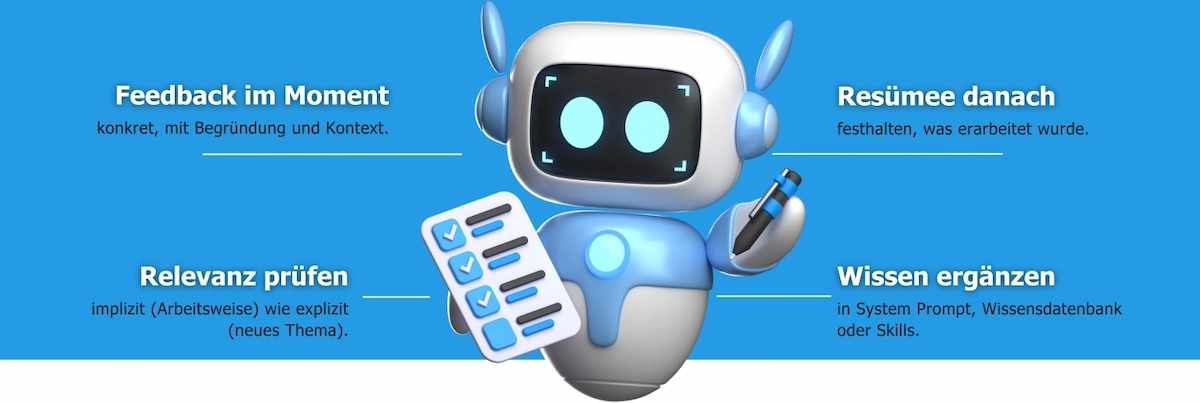
1. Feedback in the moment. Direct, and as detailed as possible.
Not “that doesn’t work”. But: what doesn’t work, why, and what it would need to look like in the given context. An agent can only process a correction if it names what is meant. Blanket dissatisfaction is not feedback. It is just frustration aimed at someone.
2. A summary afterwards. The underestimated part, and the more valuable one.
After a piece of work, we sum up with the agent what we have worked out. And we check one question: is this insight relevant for future work, and does the agent already carry it?
Relevance has two faces. Implicit: a way of working, an approach that has proven itself. Explicit: a new topic, a new line of business, a decision that applies from now on.
Do the system prompt, knowledge base or skills already carry it? If so, good. If not, we add it, where it belongs.
The reflex to skip this step is understandable. The summary feels like extra work, especially when time is short. But it is the investment that earns interest: what we secure in five minutes today, the agent does not have to learn again tomorrow.
That is how a one-off chat turns into lasting capability, and the abstract “improving an agent” into a visible routine. This is exactly phase 6 of the model put into practice every day.
Both are unspectacular. No tool trick, no secret prompt formula. Two disciplines: give precise feedback in the moment, and afterwards pause briefly to secure what the collaboration has learned.
And both are transferable, regardless of the use case and the model you work with.
An agent does not get better because you use it more often. It gets better because you look after it.
How do you handle this when working with AI: do you give feedback and secure what you have learned, or do you start from scratch again next time? Write to us. We are happy to share our approach.*